
Menopause belly is the shift of body fat toward the waist that many women notice during perimenopause and after their final period. More of that fat is visceral (stored deep around the organs), not just under the skin. Two forces drive it. Falling estrogen changes where your body stores fat, moving it from the hips…
Menopause belly is the shift of body fat toward the waist that many women notice during perimenopause and after their final period. More of that fat is visceral (stored deep around the organs), not just under the skin. Two forces drive it. Falling estrogen changes where your body stores fat, moving it from the hips and thighs to the abdomen. Aging, muscle loss and a slower metabolism change how much fat you carry. In the large SWAN study, the speed-up in fat gain began about two years before the last period. What helps is strength training, regular aerobic activity, protein- and fiber-forward eating, better sleep and stress care, and, for some women, a medically supervised plan. Menopause belly is a biological change, not a failure of willpower, and it responds to the right approach.
This table sums up the main causes and what actually helps. Each row is explained in detail below.
| Cause | What’s happening | What helps |
|---|---|---|
| Falling estrogen | Fat storage shifts from hips and thighs to the abdomen, including deeper visceral fat | Lifestyle changes below; hormone therapy may be considered for menopause symptoms after a medical evaluation (not as a belly-fat treatment) |
| Muscle loss | Lean mass starts to decline during the transition, lowering the calories your body uses | Strength training on at least 2 days a week; protein at each meal |
| Lower energy use and fat burning | Resting energy use and fat oxidation drop in women who become postmenopausal | Daily movement, 150+ minutes of aerobic activity a week, modest (not extreme) calorie adjustments |
| Hot flashes and poor sleep | Night sweats and broken sleep make healthy routines harder and can raise appetite | Sleep routines; talk to a clinician about treating disruptive hot flashes |
| Stress and lifestyle drift | Busier midlife schedules, less activity, more snacking or alcohol | Stress management, a food journal, limiting alcohol |
“Menopause belly” isn’t a medical diagnosis. It’s the everyday name for central (abdominal) fat gain around the menopause transition. It can start in perimenopause, the years of irregular cycles before your final period, and continue into postmenopause, which begins 12 months after your last period.
Subcutaneous fat sits just under the skin; it’s the soft layer you can pinch. Visceral fat sits deeper, around organs like the liver and intestines. You can’t pinch it, but it pushes the belly outward and makes it feel firmer.
The type matters because visceral fat is metabolically active. It’s linked much more strongly than pinchable fat to high blood sugar, unhealthy cholesterol and heart disease. (Our article on the risks of belly fat explains the general picture.) Menopause seems to affect visceral fat in particular. In a four-year study of 156 women that measured abdominal fat with CT scans, published in the International Journal of Obesity, all the women gained subcutaneous belly fat over time. Only those who became postmenopausal had a significant increase in visceral fat.
Most women describe a shift from a “pear” shape (fuller hips and thighs) toward an “apple” shape (fuller through the middle):
Research backs up this shape change. A meta-analysis of 201 cross-sectional studies covering more than one million women, published in the American Journal of Obstetrics & Gynecology, found that postmenopausal women had a higher trunk-fat percentage (+5.49 percentage points) and a lower leg-fat percentage (−3.19 points) than premenopausal women. A belly that swells and shrinks during the day is a different issue, usually bloating (see the “Something Else?” section below).
What causes menopause belly is several changes stacking up at once, which is why it can feel so sudden.
Before menopause, estrogen tends to direct fat toward the hips, buttocks and thighs. As estrogen levels fall, the balance shifts. Relative to estrogen, women have more androgen (testosterone-type) activity after menopause, and the authors of the meta-analysis above link that higher androgen-to-estradiol ratio to more fat stored centrally. That’s why “estrogen belly fat” is a real phenomenon, even when total calories haven’t changed. For a broader look at the hormones involved in weight, see which hormones affect obesity and weight loss.
Muscle burns more energy at rest than fat, and midlife is when it starts to decline. In the SWAN body-composition analysis, published in JCI Insight, women went from slowly gaining lean mass before the transition to losing about 0.06 kg a year during it, while fat gain nearly doubled.
Energy use falls too. In the International Journal of Obesity study, fat oxidation (how much fat the body burns for fuel) dropped by 32% in women who became postmenopausal. Their energy use during sleep fell by 7.9%, compared with 5.3% in women who stayed premenopausal. The same eating pattern that kept your weight steady at 40 may lead to slow gain at 50.
A review in Mayo Clinic Proceedings describes midlife weight gain as the result of aging and falling estrogen, plus practical barriers: hot flashes and night sweats (vasomotor symptoms), mood changes and sleep disturbance. Poor sleep affects the hunger hormones ghrelin (which drives appetite) and leptin (which signals fullness); our guide to how hormones affect weight loss explains how they work. Ongoing stress raises cortisol, a hormone tied to belly-fat storage and cravings. If stress seems to be a big factor for you, read our article on how to lower high cortisol levels. This is often what people mean by “hormonal belly fat”: several hormones shifting at once, not one broken gland.
Visceral fat and insulin resistance feed each other. When cells respond less well to insulin, the body makes more of it, which favors fat storage around the middle, and more visceral fat worsens insulin resistance. Left unchecked, the cycle can lead to prediabetes and type 2 diabetes. Our article on insulin resistance and how to keep it from becoming diabetes covers the warning signs and the lab tests that detect it.
Not every larger waist after 45 is about hormones. Diet quality, alcohol, certain medications and conditions such as an underactive thyroid can all add weight around the middle. Our overview of the common causes of belly fat covers the everyday diet-related drivers.
Is it menopause or simply getting older? Both, but they do different things. Aging mostly explains how much fat you gain; the transition mostly explains where it goes and how fast it builds for a few years. Three key studies, side by side:
| Study | Who and how many | What changed | What it means for you |
|---|---|---|---|
| SWAN body-composition analysis, JCI Insight (2019) | 1,246 women followed through the transition, body composition measured by DXA scan | Fat gain rose from about 0.25 to 0.45 kg a year; lean mass began to decline; fat mass rose about 6% over the roughly 3.5-year transition. Body weight and BMI did not speed up. | The change is real and has a timeline. It starts about 2 years before your final period and levels off about 2 years after. The scale alone can miss it. |
| Four-year CT study, International Journal of Obesity (2008) | 156 women, initially premenopausal | Everyone gained subcutaneous belly fat; only women who became postmenopausal gained significant visceral fat. Fat oxidation fell 32% in that group. | Menopause specifically affects the deeper, higher-risk fat, not just the pinchable layer. |
| Meta-analysis, American Journal of Obstetrics & Gynecology (2019) | 201 cross-sectional studies (more than 1 million women) plus 11 longitudinal studies | Postmenopausal women had a waist about 4.63 cm larger, 26.9 cm² more visceral fat area, more trunk fat and less leg fat. Most of the increase in total fat was explained by age. | Aging adds fat; menopause moves it to the middle. Both are worth acting on. |
The meta-analysis concluded that the change in total fat “was attributable predominantly to increasing age,” while the drop in leg fat and the rise in central fat point to a redistribution after menopause. Your belly isn’t growing because you suddenly started doing everything wrong; your body is reorganizing fat storage, and that takes a more deliberate response than it did at 35.
Many women notice belly changes while they still have periods. In SWAN, faster fat gain and lean-mass loss began about two years before the final period and stabilized about two years after. So perimenopause belly fat is common, and the steps below apply in your 40s as much as after menopause. The fast phase is time-limited, but the fat gained during it doesn’t leave on its own.
Menopause weight gain doesn’t always show on the scale. In SWAN, weight kept climbing at the same slow pace as before, even as fat mass sped up and lean mass fell. Lose a little muscle and gain a little fat, and your weight can stay nearly flat while your waist grows. That’s why the tracking tool below uses a tape measure.
Menopause belly fat is more than a clothing-size issue. The Mayo Clinic Proceedings review notes that central obesity is linked to dysglycemia (abnormal blood sugar), dyslipidemia (unhealthy cholesterol and triglycerides), high blood pressure and cardiovascular disease, which it identifies as the leading cause of death in postmenopausal women. The American Heart Association has likewise described the “adverse alterations in body composition” across the menopause transition as a factor in women’s later heart-disease risk.
Waist size is a simple way to estimate that risk. The National Heart, Lung, and Blood Institute treats a waist over 35 inches in women as a marker of higher risk for heart disease and type 2 diabetes (the measuring method is in the tracking section below). Our article on the risks of excess belly fat covers the broader health effects in more detail. Menopause is also when bone loss speeds up, so any plan should protect bone as well as trim the waist. Our guide to minimizing your osteoporosis risk explains why weight-bearing exercise and adequate nutrition matter during weight loss.
Not every change in your belly at midlife is fat. Bloating, weakened core muscles and some medical conditions can look similar. Use this table to think through what you’re feeling. It is not a way to diagnose yourself; when in doubt, get checked.
| Pattern | What it feels like | What usually helps | Who to see, and when |
|---|---|---|---|
| Subcutaneous fat | Soft and pinchable; stays about the same through the day | Overall fat loss through nutrition and activity | Primary care or a weight-management clinic if you want support |
| Visceral fat | Firm, rounded belly that’s hard to pinch; waist keeps growing | Strength and aerobic training, nutrition changes, a medical plan if indicated | A clinician to check blood sugar, cholesterol and blood pressure, especially if your waist is over 35 inches |
| Everyday bloating | Comes and goes; flatter in the morning and bigger after meals | Adjusting meal size, fiber pace, carbonated drinks; tracking triggers | A clinician if it’s new and persistent, or comes with the red flags below |
| Core-pressure or pelvic-floor change | A lower-belly “pooch” that bulges more when you strain, lift or cough; may come with leaking urine | Core and pelvic-floor exercises taught by a professional | A pelvic-floor physical therapist or your gynecologist |
| Underactive thyroid | Weight gain along with fatigue, feeling cold, constipation or dry skin | Treatment of the thyroid condition if diagnosed | Primary care for a blood test; symptoms alone can’t confirm it |
| Red-flag pattern | Bloating, pelvic or belly pain, or feeling full quickly that lasts 2 weeks or more; any bleeding after menopause | Prompt medical evaluation, not lifestyle changes | A doctor promptly; bleeding after menopause right away (see the red-flags section) |
The thyroid row matters because the symptoms overlap with menopause. According to the National Institute of Diabetes and Digestive and Kidney Diseases (NIDDK), fatigue and weight gain are symptoms of hypothyroidism, women are much more likely than men to develop it, and diagnosis can’t be based on symptoms alone; doctors use thyroid blood tests to confirm it.

If you want to know how to get rid of menopause belly naturally, these lifestyle steps are the foundation. They’re also the base of any medical plan, because medication and hormones don’t replace them.
If you add only one habit, make it resistance training, the most direct way to slow midlife muscle loss. A systematic review and meta-analysis of 20 randomized controlled trials in 742 postmenopausal and older women, published in the Journal of Sport and Health Science, found that resistance training reduced total and abdominal fat compared with not training, and waist circumference fell by about 2 cm. The authors rated the effects as small and the certainty of the evidence as low. Its biggest value is preserving muscle while you lose fat.
Our guide to exercise for weight loss includes beginner-friendly routines. Protecting muscle matters even more if you lose weight quickly or with medication, as our article on muscle loss during weight loss explains.
The Physical Activity Guidelines for Americans recommend 150 to 300 minutes a week of moderate aerobic activity (brisk walking, cycling, swimming) plus muscle-strengthening on 2 or more days. Walking counts, and short bouts add up. Intervals of harder effort are optional; consistency matters more than intensity.
With less muscle and less fat burned for fuel, the portions that worked before may now lead to slow gain. Aim for a modest adjustment, not a crash diet:
For a fuller framework, see our nutrition for weight loss guide, and try volume eating if hunger is your main obstacle.
Because hot flashes and poor sleep are barriers to weight control at midlife, treating them is part of treating menopause belly. Keep a cool, dark bedroom and consistent sleep times, and limit alcohol and late caffeine. If night sweats wake you several times a night, talk to a clinician; effective treatments exist. Walking, breathing exercises and planned breaks help with stress, and if stress drives your eating, our article on how stress eating hurts weight loss offers practical tactics. Logging what, when and why you eat shows patterns quickly; here’s how to create a food journal.
If you want to know how to lose belly fat after menopause, the most realistic answer is a slow, steady combination of the steps above, given at least 12 weeks before you judge the results.
Does HRT help with menopause belly? Research suggests hormone therapy is associated with less visceral fat while women are taking it, but it is not an approved or recommended treatment for belly fat.
FDA status, as of October 2026: The FDA has approved menopausal hormone therapies for moderate-to-severe hot flashes, vaginal dryness and discomfort, and preventing bone loss. No hormone therapy is FDA-approved to treat belly fat or for weight loss. In February 2026 the FDA approved labeling changes that removed risk statements about cardiovascular disease, breast cancer and probable dementia from the boxed warning of six hormone therapy products. The agency noted that benefits have been seen when treatment begins within 10 years of the onset of menopause (generally before age 60).
Who it may fit: According to The North American Menopause Society’s 2022 hormone therapy position statement, hormone therapy is the most effective treatment for hot flashes and the genitourinary syndrome of menopause. Its benefits generally outweigh the risks for women younger than 60 or within 10 years of menopause onset who have no contraindications. The same statement raises safety concerns about compounded bioidentical hormones: they have minimal government regulation and monitoring, carry a risk of overdosing or underdosing, and lack scientific efficacy and safety data. Compounded bioidentical products are not FDA-approved.
What this means in practice: HRT and BHRT always require a medical evaluation, a review of your personal and family history (including blood clots, stroke, heart disease and breast cancer), and ongoing supervision. They are never something to start on your own. Risks and contraindications differ from woman to woman; the hormone balancing guide linked above covers them in more detail. If hot flashes and poor sleep are wrecking your routines, treating them may make your weight plan easier to follow, which is a reasonable reason to discuss hormone replacement therapy for women with a clinician. Hoping hormones will shrink your waist is not. Our hormone optimization page explains how the clinic approaches hormone evaluations.
When lifestyle changes aren’t enough, women often ask about menopause belly fat treatment options beyond HRT. Here is an honest look at what each can and can’t do.
Prescription weight-management medications are approved for obesity, not for menopause. For example, the FDA approved Zepbound® (Tirzepatide) in November 2023 for chronic weight management, alongside a reduced-calorie diet and increased physical activity, in adults with a BMI of 30 or higher, or 27 or higher with at least one weight-related condition such as high blood pressure, type 2 diabetes or high cholesterol. As of October 2026, no GLP-1 or related medication is approved specifically for “menopause belly.” Eligibility depends on BMI and health conditions, not on menopausal status.
Side effects listed by the FDA include nausea, diarrhea, vomiting, constipation, abdominal discomfort and pain, injection-site reactions, fatigue, hypersensitivity (allergic) reactions, burping, hair loss and heartburn (GERD). These medications need a prescription, screening and follow-up. Our page on Tirzepatide (Mounjaro® and Zepbound) explains how the clinic evaluates candidates, and medical weight loss in Pembroke Pines describes the broader supervised program for women who qualify.
Non-surgical body contouring treatments act on the pinchable subcutaneous fat in a specific treated area. They can refine the shape of a stubborn area for someone who is near their goal weight. They cannot reach visceral fat, which sits beneath the abdominal muscles, so they don’t change the health risks linked to a growing waist. They’re also not a substitute for weight loss. Results may vary from person to person, and the goal is natural-looking results, not a dramatic transformation. Think of contouring as a finishing step after the foundations, not a first step.
If you decide to get help, here’s how our clinicians typically approach a midlife belly-fat concern. Your visit may differ depending on your history and goals.
You can read more about our approach to medically supervised care.
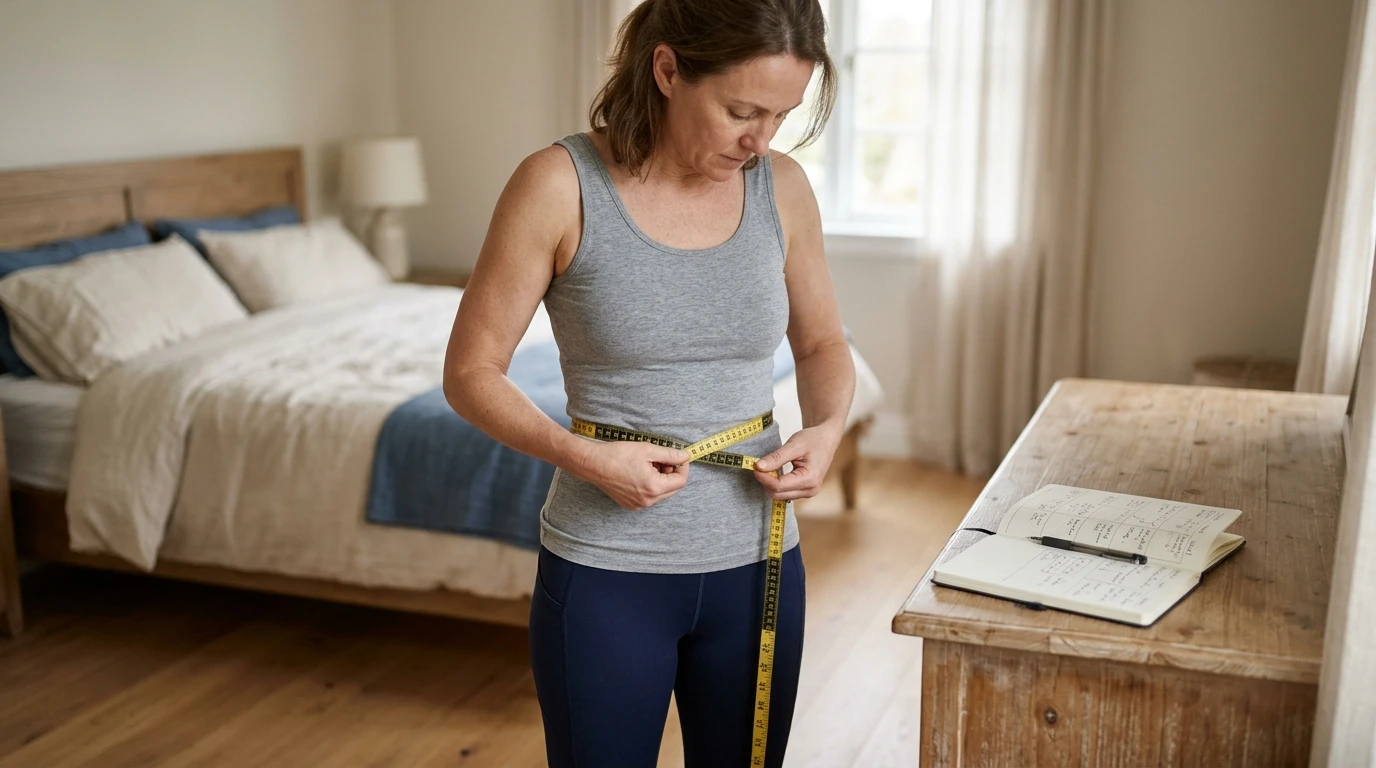
Because the scale can stay flat while your waist changes, a tape measure is the better tool. Here’s a simple system you can start today.
The National Heart, Lung, and Blood Institute recommends this method:
Measure at the same time of day, ideally in the morning before eating, once a week. A waist over 35 inches is the NHLBI’s marker of higher risk. More tips on tracking progress are in our article on how to get rid of belly fat.
| Week | Waist (inches) | Strength sessions (goal: 2+) | Aerobic minutes (goal: 150+) | Nights of good sleep (out of 7) | Nights disrupted by hot flashes |
|---|---|---|---|---|---|
| 1 | |||||
| 2 | |||||
| 3 | |||||
| 4 | |||||
| 5–8 | |||||
| 9–12 |
Copy the rows for weeks 5 through 12 or log them individually. Week-to-week changes are small and noisy; compare week 1 with week 12.
Keep going with self-care if:
Book an evaluation if:
See a doctor promptly if:
Most menopause belly is a gradual change in body composition. But some belly symptoms in midlife are warning signs that need medical attention, not lifestyle changes. According to the CDC, symptoms of ovarian cancer can include:
The CDC advises seeing a doctor right away for unusual vaginal bleeding, and seeing a doctor if any of the other signs last two weeks or longer and aren’t normal for you. These symptoms usually have other, less serious causes, but they need to be checked. Also book a prompt visit for rapid, unexplained weight gain or swelling, particularly with swollen legs or shortness of breath.
Go to urgent care or the emergency room for severe belly pain, a hard and swollen abdomen, vomiting that won’t stop, fever with belly pain, or chest pain or trouble breathing.
Menopause belly sits where hormones and weight overlap, and many women end up shuttling between separate offices for each. At Cardiomender Weight Loss & Aesthetics, both are evaluated in the same clinic:
You can see how the clinic’s weight loss program is structured before you book.
The fast phase does settle. In the SWAN study, fat gain and muscle loss leveled off about two years after the final period. But fat gained during the transition doesn’t leave on its own. Lifestyle changes and, for some women, medical treatment can reduce it; results vary.
There isn’t a safe shortcut: very fast loss costs muscle and makes regain more likely. A modest calorie deficit, protein at each meal, strength training twice a week and 150+ minutes of aerobic activity work best; women who meet medical criteria may also qualify for a supervised plan.
Focus on keeping muscle while losing fat: resistance training, enough protein, fiber-rich foods, less alcohol and added sugar, and good sleep. Track your waist, not just your weight.
Current hormone therapy use is linked with less visceral fat, but the benefit wasn’t seen after women stopped, and as of October 2026 HRT is not FDA-approved for weight loss or belly fat. It may help indirectly by easing symptoms and improving sleep, and it requires a medical evaluation and supervision.
Around menopause, many women lose a little muscle and gain a little fat, and more of it settles at the waist. In SWAN, fat gain sped up while body weight did not.
Yes. The shift of fat from the hips and legs to the middle is linked to hormonal changes, not just weight, so waist size is worth tracking at any weight.
Usually not. For women 45 and older, guidelines such as NICE’s identify menopause from symptoms and cycle changes. Blood work is still useful to rule out thyroid problems and check blood sugar and cholesterol.
No. Menopause belly is a lasting change in fat, while bloating comes and goes, often after meals. Bloating that lasts two weeks or more, especially with pelvic pain or early fullness, should be checked by a doctor.
It depends on the treatment and the type of fat. Lifestyle changes reduce both kinds; weight-management medication can help women who meet BMI-based criteria; body contouring only reduces pinchable fat in a treated area. Results may vary.
If menopause belly is affecting your health or confidence, you don’t have to sort it out alone. Book your consultation at Cardiomender Weight Loss & Aesthetics through our appointment request page or call (954) 799-6439. Serving patients across South Florida from our Pembroke Pines clinic, our team can review your symptoms, labs and goals and build a medically supervised plan that fits midlife.
Our physician-supervised weight loss and aesthetic programs are designed around your unique body, goals, and lifestyle.