The most common low estrogen symptoms are hot flashes and night sweats, irregular or missed periods, vaginal dryness or painful sex, poor sleep, mood changes and brain fog. Less obvious signs include achy joints, drier and thinner skin, and more frequent urinary tract infections. Low estrogen is most often part of perimenopause and menopause, but…
The most common low estrogen symptoms are hot flashes and night sweats, irregular or missed periods, vaginal dryness or painful sex, poor sleep, mood changes and brain fog. Less obvious signs include achy joints, drier and thinner skin, and more frequent urinary tract infections. Low estrogen is most often part of perimenopause and menopause, but it can happen at any adult age: after ovary surgery or cancer treatment, with premature ovarian insufficiency, or when stress, under-eating or heavy training shut down ovulation. Symptoms alone can’t tell you which of these is behind them. That takes an evaluation and often a blood test, and even then a single estrogen number rarely settles the question on its own. This guide covers the signs of low estrogen, what causes it at different life stages, how to test estrogen levels in a way that actually answers your question, and when a medical hormone evaluation makes sense.
If you only read one section, read this table. It sums up the signs of low estrogen, the usual causes and the first steps a clinician takes.
| Question | Short answer |
|---|---|
| Most common signs | Hot flashes, night sweats, irregular or missed periods, vaginal dryness, painful sex, low libido, poor sleep, irritability or low mood |
| Less-obvious signs | Brain fog, joint aches and stiffness, drier or thinner skin, recurring UTIs, dry eyes, headaches |
| Most common causes | Perimenopause and menopause; removal of both ovaries; chemotherapy or pelvic radiation; premature ovarian insufficiency; stress, under-eating or heavy training; pituitary or thyroid conditions |
| First tests a clinician may order | Depends on age: often FSH and estradiol, plus tests that rule out other causes (pregnancy, thyroid, prolactin). Over 45 with typical symptoms, often no hormone test is needed to diagnose menopause |
| Typical estradiol range | 30-400 pg/mL before menopause; 0-30 pg/mL after menopause (ranges vary slightly by lab) |
| When to get seen promptly | Periods stop before age 40; any bleeding after 12 months without a period; heavy bleeding; bleeding after sex or between periods |
Estrogen isn’t a single hormone. According to MedlinePlus, the National Library of Medicine’s consumer health service, there are three main types: estradiol (E2), the main estrogen during the reproductive years; estrone (E1), the only type of estrogen the body keeps making after menopause; and estriol (E3), which rises during pregnancy. When people talk about “low estrogen levels,” they usually mean low estradiol, made mostly by the ovaries.
Low estrogen is a finding, not a single disease. Some drops are a normal part of life, such as the gradual decline of perimenopause or the temporary dip after giving birth. Others point to something that needs investigating, such as ovaries that stop working years too early or a signal problem between the brain and the ovaries. The symptoms can look the same, which is why the cause matters more than the label. Estrogen also does more than run the menstrual cycle: it supports bone strength, vaginal and urinary tissue, skin collagen, blood vessels, sleep and mood. That is why low estrogen symptoms in women show up in so many different parts of the body.
The signs of low estrogen in women tend to cluster. One symptom on its own can have many explanations, but several together, especially alongside a change in your periods, are a strong reason to look at hormones.
Cycles that get shorter, longer, lighter, heavier or start skipping are often the first sign. In perimenopause this is expected: the National Institute on Aging notes that the transition usually begins between ages 45 and 55. Periods that become irregular or stop well before that, especially before 40, are a different story and should be evaluated (more on that in the causes section).
A hot flash is a sudden wave of heat, usually over the face, neck and chest, often followed by sweating and chills. At night, the same thing shows up as night sweats that wake you up. These vasomotor symptoms (symptoms caused by changes in blood-vessel tone) last much longer than many people expect. The Study of Women’s Health Across the Nation (SWAN), published in JAMA Internal Medicine, followed 3,302 women at seven US sites and found a median total duration of 7.4 years for frequent hot flashes and night sweats, continuing a median of 4.5 years after the final period. Women whose hot flashes started before or early in perimenopause had them for more than 11.8 years, and African American women had the longest duration, a median of 10.1 years.
Estrogen keeps vaginal and urinary tissue thick, moist and elastic. When it falls, many women notice dryness, burning, itching, pain during sex, lower desire, a more urgent need to urinate, or more frequent urinary tract infections. Doctors group these changes under the name genitourinary syndrome of menopause (GSM). In its 2020 position statement, The Menopause Society estimates that GSM affects roughly 27% to 84% of postmenopausal women and is likely underdiagnosed, partly because many women never bring it up. The same statement notes that in most cases these symptoms can be effectively managed, so they are worth mentioning at your visit.
Night sweats break up sleep, and poor sleep in turn feeds irritability, anxiety, low mood and fatigue. Some women notice mood changes even without hot flashes. These symptoms overlap heavily with stress, thyroid problems and depression, so they deserve a proper look rather than an assumption that “it’s just hormones.” If you’re already on hormone therapy and your mood is swinging, our guide to HRT mood swings and how to manage them covers that side of the story. Long-term stress is also part of the picture for many patients, since it affects sleep and appetite, and our article on high cortisol and how it’s treated explains how it interacts with other hormones.

Some of the weird symptoms of low estrogen are easy to blame on aging, stress or a bad mattress. Women often see three or four different specialists before anyone connects them to hormones.
Forgetting words, losing your train of thought or struggling to focus are common complaints during the menopause transition. They often improve as sleep improves, which is another reason treating night sweats can matter. Brain fog that is getting steadily worse, or that comes with other neurological symptoms, should be evaluated on its own rather than written off as hormonal.
Aching knees, stiff hands in the morning and sore shoulders are surprisingly common. A 2024 review in Climacteric describes a “musculoskeletal syndrome of menopause” and reports that more than 70% of women have musculoskeletal symptoms through the transition, with 25% disabled by them. The authors describe joint pain, loss of muscle and bone, and progression of osteoarthritis as largely influenced by changing estrogen levels. Joint pain still has many other causes, including arthritis and injury, so swollen, hot or red joints need their own evaluation.
“Low estrogen face” is the search term people use for skin that suddenly looks drier, thinner, duller or more lined. There is a biological reason for it. A review in Dermato-Endocrinology explains that estrogen deficiency is linked to thinner skin, less collagen, reduced elasticity, more wrinkling, dryness and slower wound healing, and that skin collagen is thought to drop by as much as 30% in the first five years after menopause. Hormones are only one part of skin aging, along with sun exposure, genetics and smoking. If skin texture or volume bothers you, skin-focused aesthetic treatments can be discussed separately from hormone care. They don’t treat low estrogen, results may vary from person to person, and the goal is natural-looking results.
Can low estrogen cause weight gain? The honest answer is “partly, but probably not the way you think.” The link between low estrogen and weight gain is real, but it’s more about body composition than pounds. The best data come from SWAN’s body-composition analysis, published in JCI Insight. At the start of the menopause transition, the rate of fat gain roughly doubled and lean (muscle) mass started to decline, a pattern that continued until about two years after the final period. Total body weight did not accelerate at the same point. In other words, falling estrogen seems to shift body composition toward more fat and less muscle more than it pushes up the number on the scale, and many women notice it first as a thicker waist.
That shift matters because muscle helps set your resting metabolism, and fat around the abdomen is more closely tied to metabolic and heart risk. Our article on how hormones affect weight loss explains the wider hormonal picture, including insulin, cortisol and thyroid hormones, and our guide to the causes of belly fat covers why midsection weight in particular is so stubborn. If weight is a central concern alongside other symptoms, a medically supervised weight loss program can be planned together with a hormone evaluation, so both are looked at with the same lab results.
What causes low estrogen depends heavily on your age and history. The causes of low estrogen fall into four broad groups.
The most common cause is the natural decline of ovarian function. The National Institute on Aging puts the average age of menopause in the US at 52, and menopause is confirmed only after 12 months in a row without a period or spotting. In the years before that, during perimenopause, estrogen doesn’t fall in a straight line. It swings up and down, which is why symptoms can come and go and why a single lab result can mislead. Our guide to weight gain with aging covers the metabolic changes that often arrive at the same time.
Low estrogen in younger women is never something to simply wait out. The two most important causes are:
Removing both ovaries ends ovarian estrogen production at once, and the National Institute on Aging notes that menopause symptoms may start immediately afterward. A hysterectomy that leaves the ovaries in place doesn’t do this directly, though periods stop. Chemotherapy and pelvic radiation can damage the ovaries and cause POI, which the 2024 guideline addresses directly. Some breast cancer and endometriosis treatments deliberately lower estrogen. If you’re on one of these, talk to your oncology team or prescriber before considering any hormone treatment, because estrogen may be exactly what the treatment is designed to block.
MedlinePlus lists pituitary and thyroid disorders among the reasons clinicians order estrogen testing, because problems with these glands can disrupt the signals that drive the ovaries. Very low body fat and rapid weight loss can also lower estrogen. After childbirth, and especially while breastfeeding, estrogen drops temporarily; this is normal and usually settles as cycles return. In girls and teens, delayed breast development or periods that haven’t started by the mid-teens should be evaluated by a pediatric or adolescent specialist.
This is the part most articles skip. Knowing how to test estrogen levels is less about the blood draw itself and more about choosing the right test at the right time, and knowing what a result can and can’t tell you.
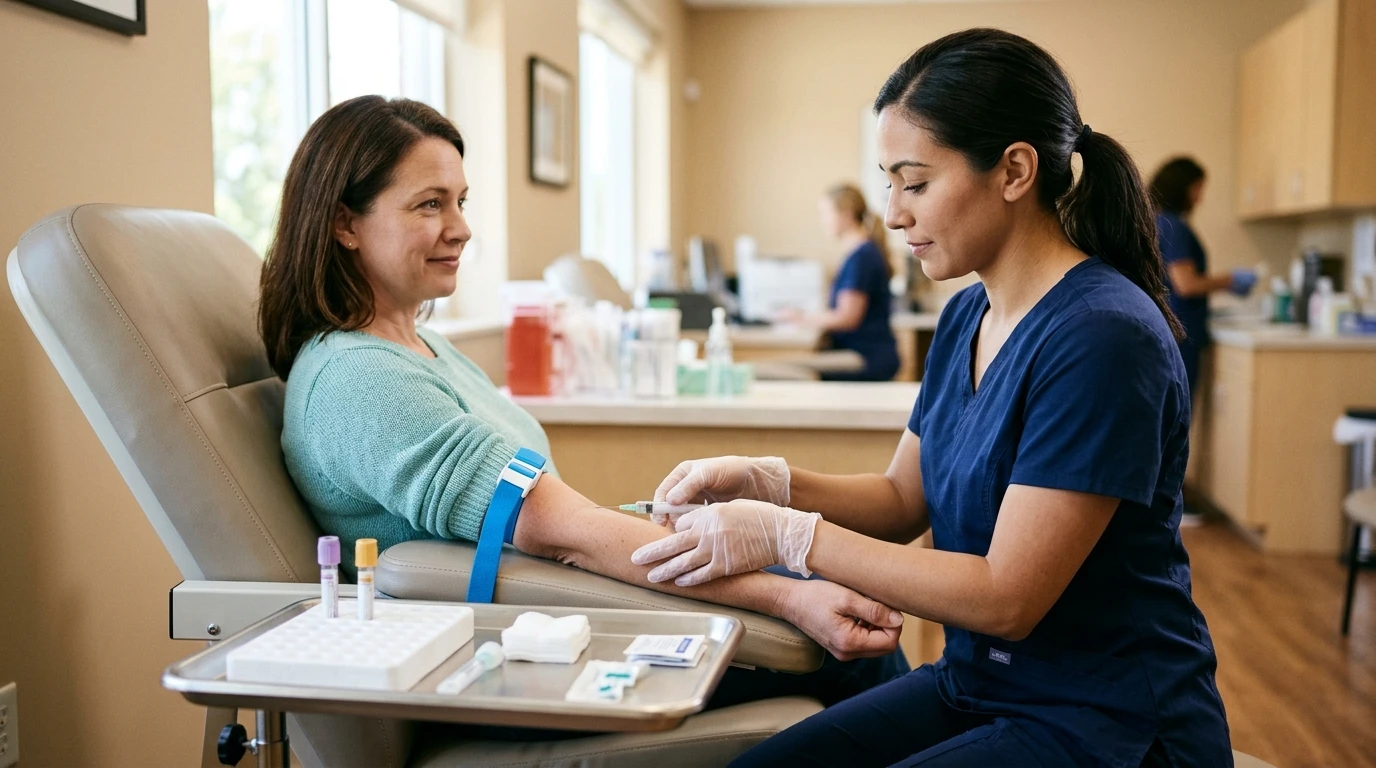
The estradiol test is a standard blood draw from a vein in your arm. It measures E2, the main estrogen of the reproductive years. MedlinePlus lists typical normal ranges as follows:
| Group | Typical estradiol range | What to keep in mind |
|---|---|---|
| Women, before menopause | 30-400 pg/mL | The range is wide because estradiol rises and falls across the menstrual cycle. A value low in the range can be normal on certain cycle days. |
| Women, after menopause | 0-30 pg/mL | Low estradiol is expected after menopause and doesn’t need “fixing” by itself; symptoms guide treatment. |
| All results | Varies slightly by lab | Always compare your result with the reference range printed on your own lab report. |
MedlinePlus lists absent periods (amenorrhea), reduced ovarian function, genetic conditions such as Turner syndrome, and rapid weight loss or low body fat among the conditions linked to abnormal results. A low estrogen test result is a clue that points your clinician toward these possibilities. It isn’t a diagnosis on its own.
MedlinePlus explains that because estrogen levels fluctuate considerably, you may need to be tested more than once to look for a trend over time. A “healthy” level depends on your age, why you’re being tested, which estrogen is measured and your other results. Timing in the cycle matters, and in perimenopause levels can be normal one week and low the next.
Medicines also change results. MedlinePlus lists birth control pills, certain antibiotics, corticosteroids, DHEA, estrogen, some medicines for mental-health conditions, and testosterone as possible influences. It also warns not to stop taking any medicine before talking to your provider, so bring a full list to your visit instead of stopping anything on your own.
National guidelines such as the UK’s NICE menopause guideline (NG23) are clear that hormone tests are useful in some situations and unhelpful in others. This table combines NICE with the POI and FHA guidelines above.
| Your situation | What testing usually looks like | Why |
|---|---|---|
| Over 45 with typical symptoms and changing periods | Usually no hormone test needed; diagnosis is based on symptoms and cycle pattern | NICE advises against using estradiol, AMH, inhibin, antral follicle count or ovarian volume to identify perimenopause or menopause at age 45 or over |
| Age 40-45 with symptoms and cycle changes | FSH may be considered | NICE limits FSH testing for menopause to this group and to women under 40 |
| Under 40, periods irregular or stopped | FSH, often with estradiol, plus tests to rule out pregnancy, thyroid and prolactin problems | Under the 2024 POI guideline, one FSH level above 25 IU/L in this setting is enough to support a POI diagnosis; FSH and/or AMH is repeated if the picture is unclear |
| Missed periods with heavy training, weight loss or major stress | A broader workup to rule out other causes before settling on FHA | The Endocrine Society calls FHA a diagnosis of exclusion |
| On combined hormonal birth control or high-dose progestogen | FSH is not used to diagnose menopause | NICE advises against using an FSH test to identify menopause in people taking these medicines; birth control pills can also affect estradiol results |
| During or after cancer treatment, or after ovary removal | Testing is guided by your oncology or surgical team | The cause is already known; the question is safe symptom management |
Estrogen is rarely tested alone. FSH (follicle-stimulating hormone) and LH (luteinizing hormone) show whether the brain is pushing hard on ovaries that aren’t responding, as in menopause and POI, or barely signaling at all, as in FHA. A pregnancy test, TSH (thyroid) and prolactin help rule out common look-alikes. At Cardiomender Weight Loss & Aesthetics, hormone care for women starts with a medical history, a physical exam and hormone blood tests that confirm whether treatment is clinically appropriate. Blood work is required before any treatment, and it also screens for conditions that can affect or mimic a hormonal imbalance.
MedlinePlus notes that estrogen can be measured in blood or urine, and that at-home kits, commonly using saliva, are available. Because estrogen changes so much day to day, an at-home number has the same limits as a single lab result, and it can’t rule out pregnancy, thyroid disease or POI. If you’ve used one, bring the result to a clinician as a starting point for the conversation, not as a diagnosis.
Some low estrogen effects can’t be felt but matter more over time than hot flashes do.
Bones. Estrogen slows bone breakdown, and bone loss starts earlier than most people think. In SWAN’s bone study, published in the Journal of Bone and Mineral Research, bone density began falling about one year before the final period. Over ten years the lumbar spine lost 10.6% of its density, and 7.38% of that was lost in the roughly three-year window around the final period. Women with POI or long-standing FHA face bone loss much earlier in life, which is one reason both guidelines call for treating the underlying cause rather than waiting. Our article on reducing osteoporosis risk covers practical steps, and our guide to vitamin D deficiency explains why that lab value matters for bone health too.
Heart and metabolism. Cardiovascular disease is the leading cause of death in women, and an American Heart Association scientific statement describes how risk rises after menopause, with unfavorable changes in body composition, cholesterol and blood-vessel health across the transition. The AHA frames midlife as a window for early prevention. Our tips for a strong heart and our article on insulin resistance cover the habits and labs that matter most during these years.
This table is a guide to starting the right conversation, not a diagnosis. Many symptoms have more than one possible cause, and a clinician will rule out other explanations first.
| What you notice | What may be behind it | Who usually evaluates it |
|---|---|---|
| Hot flashes, night sweats and changing periods after 40 | Perimenopause or menopause | Primary care, a gynecologist, or a clinic that provides supervised hormone care |
| Periods irregular or stopped before 40 | Possible POI; also pregnancy, thyroid or prolactin problems | Gynecology or reproductive endocrinology, promptly |
| Missed periods with intense training, dieting or major stress | Possible functional hypothalamic amenorrhea | A clinician working with a dietitian and mental-health support, as the Endocrine Society recommends |
| Vaginal dryness, painful sex or recurring UTIs | Genitourinary syndrome of menopause (after ruling out infection) | A gynecologist or primary care clinician |
| New joint aches and morning stiffness in midlife | Musculoskeletal syndrome of menopause, or arthritis | Primary care; rheumatology if joints are swollen, hot or red |
| Hot flashes during or after cancer treatment | Treatment-related estrogen loss | Your oncology team first |
| Any bleeding after 12 months without a period | Needs to be checked; not a normal menopause symptom | A gynecologist, promptly |
| No breast development or no period by the mid-teens | Delayed puberty with several possible causes | A pediatric or adolescent specialist |
Low estrogen treatment depends entirely on the cause. For FHA, the Endocrine Society recommends a team approach that covers medical, dietary and mental-health support to address the stress, under-eating or training load behind it. For POI, the 2024 guideline notes that hormone therapy can mitigate some of the effects on bone, heart and overall health, with the plan tailored to each woman. For menopause, treatment is about relieving symptoms that affect your quality of life.
Hormone therapy. The Menopause Society’s 2022 hormone therapy position statement calls hormone therapy the most effective treatment for hot flashes and for genitourinary syndrome of menopause, and notes it has been shown to prevent bone loss and fracture. The statement also says benefits are most likely to outweigh risks for women under 60 or within 10 years of menopause onset who have no contraindications, and that treatment should be individualized and reevaluated periodically. HRT, including BHRT, always requires a medical evaluation, a diagnosis and ongoing supervision. It is never something to start on your own, and the decisions about type, dose and route belong to you and your clinician together.
What the FDA has and hasn’t approved. The FDA has approved hormone therapies for moderate-to-severe hot flashes, vaginal dryness and discomfort, and preventing bone loss. In February 2026, the agency approved labeling changes for six products that remove the risk statements about cardiovascular disease, breast cancer and probable dementia from the boxed warning, and 29 companies submitted proposed labeling changes at the FDA’s request. According to the FDA’s consumer update, the boxed warning about endometrial cancer remains for systemic estrogen-alone products. A note on “bioidentical”: FDA-approved estradiol products are themselves bioidentical, meaning chemically identical to the estradiol your ovaries make. Custom-compounded hormone formulations are not FDA-approved, and the American College of Obstetricians and Gynecologists recommends FDA-approved hormone therapy over compounded preparations when an approved option meets a patient’s needs.
Risks and side effects. Hormone therapy is not risk-free. The Menopause Society explains that risks differ by type, dose, duration, route of administration, timing of initiation and whether a progestogen is used. Starting hormone therapy more than 10 years after menopause onset or after age 60 carries greater absolute risks of coronary heart disease, stroke, blood clots (venous thromboembolism) and dementia. That is exactly why a full history, labs and follow-up visits come first.
Options for vaginal and urinary symptoms. For GSM, over-the-counter lubricants and moisturizers are a first step. When they’re not enough, low-dose vaginal estrogen is recommended, and The Menopause Society also lists vaginal DHEA, systemic hormone therapy and ospemifene as options. For hot flashes, non-hormonal prescription options also exist for women who can’t or prefer not to use hormones.
Patients come to our single Pembroke Pines clinic from across South Florida, including women who first find us through our pages on HRT for women in Fort Lauderdale and HRT for women in Miami. All evaluations and follow-ups take place at the same Pembroke Pines location.
A focused visit starts with good information. Our clinicians find that two weeks of notes make the conversation far more useful than trying to remember everything in the exam room. Before your appointment, track:
When you’re ready, you can request an appointment online and bring your log to the first visit.
Book an evaluation if:
See a clinician promptly if:
Call 911 or go to the emergency room if:
If low mood has turned into thoughts of harming yourself, call or text 988, the Suicide & Crisis Lifeline, right away.
Cardiomender has cared for South Florida patients from one in-person clinic in Pembroke Pines since 2009. Our hormone care for women follows the same logic as this article: find the cause before treating the symptom.
You can read more about our approach to care, including how we combine medical supervision with lifestyle support.
Many women describe sudden waves of heat, waking up drenched, feeling more irritable or teary than usual, and sleeping badly even when tired. Others notice vaginal dryness, achy joints or a foggy head first. Because these overlap with stress and thyroid problems, an evaluation is the only way to know whether estrogen is the cause.
Symptoms plus a change in your periods are the first clue. A clinician then decides whether testing will help: under 40, FSH and estradiol plus tests that rule out other causes are usually needed, while over 45 with typical symptoms, menopause is often diagnosed without hormone tests at all.
MedlinePlus lists 30-400 pg/mL as a typical range before menopause and 0-30 pg/mL after menopause, with slight differences between labs. Before menopause, your level depends on the day of your cycle, so the number needs to be read together with your symptoms and other results.
Yes. Premature ovarian insufficiency affects about 3.5% of women, and functional hypothalamic amenorrhea, linked to stress, under-eating or heavy exercise, is also common in younger women. Both can affect bone health and fertility, so missed periods at this age should always be evaluated.
It may play a part. A review on estrogen and aging skin notes that estrogens act on hair follicles and lists hair loss among the changes of aging skin, though the link to menopause itself is less clear-cut. But thyroid problems, low iron, rapid weight loss, stress and genetics are common causes too, so new hair thinning deserves its own check rather than an assumption.
Mostly it changes where weight goes. SWAN found the rate of fat gain roughly doubled and lean mass declined during the menopause transition, even though total weight didn’t accelerate. Strength training, enough protein and, when appropriate, supervised weight care can help.
At-home kits, often using saliva, are available. Because estrogen changes from day to day, one at-home result has real limits, and it can’t rule out other causes of your symptoms. Use it as a conversation starter with a clinician, not as a diagnosis.
Not on your own. Birth control pills can affect estradiol results, and FSH isn’t reliable for diagnosing menopause while you’re on combined hormonal contraception. MedlinePlus advises against stopping any medicine before talking to your provider, who can decide whether and how testing should be timed.
It depends on the cause. For menopause-related hot flashes and night sweats, SWAN found a median of 7.4 years, and longer for women whose symptoms started early. Vaginal and urinary symptoms follow their own course and are usually manageable with treatment, and with FHA, the outlook depends on addressing the stress, nutrition or training load behind it.
The right approach depends on why it’s low. For FHA, that may mean eating more, easing training or managing stress. For POI or bothersome menopause symptoms, it may mean prescription hormone therapy under medical supervision. Supplements sold as estrogen boosters aren’t a substitute for an evaluation.
For many women under 60 or within 10 years of menopause who have no contraindications, The Menopause Society finds the benefits are likely to outweigh the risks. Risks depend on the type, dose, route, timing and your personal history, which is why hormone therapy needs an individual evaluation and ongoing monitoring.
If you recognize several of these low estrogen symptoms, the next step is a real answer, not guesswork. Book your consultation at Cardiomender Weight Loss & Aesthetics, serving patients across South Florida from our Pembroke Pines clinic at 17009 Pines Blvd, by calling (954) 799-6439. Bring your symptom log, and we’ll start with the labs.
Our physician-supervised weight loss and aesthetic programs are designed around your unique body, goals, and lifestyle.