
Here is how to get Zepbound® without insurance. First, get a valid prescription from a licensed clinician. Then buy the KwikPen or vials through Eli Lilly’s self-pay program, either from LillyDirect or from a participating pharmacy that accepts the self-pay savings card. As of October 2026, Lilly’s coverage and savings terms put Zepbound without insurance…
Here is how to get Zepbound® without insurance. First, get a valid prescription from a licensed clinician. Then buy the KwikPen or vials through Eli Lilly’s self-pay program, either from LillyDirect or from a participating pharmacy that accepts the self-pay savings card. As of October 2026, Lilly’s coverage and savings terms put Zepbound without insurance at $299 a month for the 2.5 mg dose, $399 for 5 mg, and $449 for 7.5 mg through 15 mg, as long as each refill is on time. TrumpRx lists Zepbound’s “original” price at $1,087 a month. Keep in mind that you pay for two things: the medication and the medical care that comes with it. This guide covers both, along with the fine print that changes the real total.
Quick reference: Zepbound cost without insurance by dose (self-pay KwikPen or vials, 28-day supply, as of October 2026)
| Dose (weekly) | Self-pay price, on-time refill | Price if refill is more than 45 days late | Where it fits on the FDA label |
|---|---|---|---|
| 2.5 mg | $299 | $299 | Starting dose for the first 4 weeks only |
| 5 mg | $399 | $399 | First step-up; also a maintenance dose |
| 7.5 mg | $449 | $499 | Step-up dose |
| 10 mg | $449 | $699 | Maintenance dose option |
| 12.5 mg | $449 | $699 | Step-up dose |
| 15 mg | $449 | $699 | Maximum maintenance dose |
Sources: Eli Lilly Zepbound coverage and savings terms (self-pay prices) and the FDA-approved prescribing information (dose schedule). The late-refill prices are the ones Lilly publishes for the KwikPen; ask LillyDirect what a late vial refill costs. Manufacturer prices change often, so confirm the current price before you fill.
How much is Zepbound without insurance? Your Zepbound price without insurance depends on three things: the form of the medication, your dose, and whether you refill on time. Most people who pay cash end up somewhere between $299 and $449 a month. That is well under the list price, but it is still a large recurring cost, because the medication is meant for long-term use.
The government’s prescription site TrumpRx lists Zepbound with an “original” price of $1,087 a month and a self-pay price starting at $299. That gap is the main reason to buy through the manufacturer’s self-pay program. Paying the full pharmacy list price for the single-dose autoinjector pen is the most expensive way to fill the prescription. When people mention the Zepbound cash price, they usually mean the self-pay figures, not the list price.
One detail catches many people. The $299–$449 self-pay prices apply to the KwikPen and the vials, not to the single-dose autoinjector pen that many people picture when they think of Zepbound. Lilly’s self-pay savings card terms say this directly. If you have a commercial insurance plan that excludes Zepbound, the single-dose pen costs as little as $499 a month through the savings card. That is the floor price for that form, and it is higher than the self-pay floor. So your Zepbound out-of-pocket cost can differ by $200 a month or more depending only on which form you are prescribed.
Zepbound is started low and increased gradually. Under the FDA-approved label, everyone begins at 2.5 mg once a week for 4 weeks. After that, the dose goes up in 2.5 mg steps, with at least 4 weeks at each dose. The maintenance doses are 5 mg, 10 mg, or 15 mg. Self-pay pricing follows the same schedule, so your first month is the cheapest and the price levels off at $449 once you reach 7.5 mg. Many people also notice that both the effects and the side effects build gradually during this period. Our guide on how long Tirzepatide takes to work explains what to expect week by week.
Three conditions in Lilly’s terms change what you actually pay:

Most price guides quote one monthly figure. Your actual Zepbound cost without insurance depends on how your dose changes over time. The table below shows two examples built from the FDA label’s dose schedule and Lilly’s October 2026 self-pay prices. These are math examples, not a dosing plan. Your clinician sets your dose based on how you respond and how well you tolerate it.
| 28-day fill | Path A: dose increased every 4 weeks up to 15 mg | Path B: maintained at 5 mg |
|---|---|---|
| Fill 1 | 2.5 mg: $299 | 2.5 mg: $299 |
| Fill 2 | 5 mg: $399 | 5 mg: $399 |
| Fill 3 | 7.5 mg: $449 | 5 mg: $399 |
| Fill 4 | 10 mg: $449 | 5 mg: $399 |
| Fill 5 | 12.5 mg: $449 | 5 mg: $399 |
| Fill 6 | 15 mg: $449 | 5 mg: $399 |
| First 6 fills (about 24 weeks) | $2,494 | $2,294 |
| 11 fills, the card’s yearly maximum (about 44 weeks) | $4,739 | $4,289 |
Medication cost only, as of October 2026, assuming every refill is on time. Visits, labs, and supplies are not included.
Three conclusions from this math:
The self-pay price covers the drug only. It does not cover the visits needed to get and renew your prescription, the lab work your clinician may order before and during treatment, or follow-up visits when your dose changes or side effects need attention. Vials also require syringes and needles, and the KwikPen requires pen needles. Even under the Medicare GLP-1 Bridge, pen needles are not covered. Visit and lab prices vary widely, so ask any provider for their total program cost up front. You can see how a medically supervised program is structured on our weight loss program pricing page.
The cheapest way to get Zepbound without insurance depends on whether you have any coverage at all, and what kind. Use this table to find your situation. The sections below explain each row.
| Your situation | Usually the lowest-cost legitimate channel | Key condition to check |
|---|---|---|
| No insurance | Self-pay KwikPen or vials through LillyDirect or a participating pharmacy: $299–$449 a month | Prescription required; refill within 45 days; 11 discounted fills per year |
| Commercial plan that doesn’t cover Zepbound | Savings card for the single-dose pen (as little as $499) or self-pay KwikPen or vials ($299–$449) | Compare both at your dose; ask your prescriber about a prior authorization or appeal |
| Commercial plan that covers Zepbound | Savings card: as little as $25 for a 1-, 2-, or 3-month fill | Savings capped at $1,300 per calendar year; not available to government-program enrollees |
| Medicare Part D | Medicare GLP-1 Bridge: $50 copay for the KwikPen | BMI and health criteria; your prescriber submits the prior authorization |
| Medicaid (Florida) | Your Medicaid plan, if it covers Zepbound for your diagnosis | Coverage for obesity varies by state; check with your Florida Medicaid plan |
| TRICARE, VA, or other government plan | Your plan’s benefit, if any; otherwise self-pay pricing | Government beneficiaries can’t use the savings cards, but self-pay pricing still applies |
Based on Lilly, CMS, and KFF information as of October 2026.
If you have no insurance, Lilly’s self-pay program is the main route. LillyDirect, Lilly’s own pharmacy service, sells the Zepbound vial and the KwikPen at the self-pay prices in the table above. The medication is shipped to you. A prescription from a licensed clinician is required, and the program is open to U.S. and Puerto Rico residents age 18 and older who pay cash. Each 28-day supply comes either as four single-dose vials or as one KwikPen that holds four weekly doses. Your price is set by your dose, not by which pharmacy dispenses it.
You don’t have to use LillyDirect. When you enroll in the self-pay savings card, you can choose LillyDirect or “Other pharmacy.” Participating retail pharmacies accept the KwikPen self-pay card for cash-paying patients with a prescription. Call your local pharmacy first to confirm it participates and stocks your dose. Some people prefer picking up in person to waiting for a delivery, especially with the 45-day refill window to keep in mind.
If you’ve seen the TrumpRx Zepbound price, the answer is simpler than it looks. TrumpRx lists the Zepbound vial in strengths from 2.5 mg to 15 mg at $299 a month, labeled “Lowest Presidential Deal,” and says eligibility is required. The same product page states that “Eli Lilly and Company manages all Zepbound (Tirzepatide) Vial orders through LillyDirect®.” So TrumpRx is another way into the same LillyDirect self-pay program, not a separate, cheaper price. The $299 figure is the 2.5 mg starting price, and higher doses follow the same tiers listed above.
Many employer plans exclude weight-management drugs. If yours does, you have two choices. The Zepbound savings card for non-covered commercial plans brings the single-dose pen to as little as $499 a month. You can also pay cash for the KwikPen or vials under self-pay pricing, which costs $299–$449 by dose. Compare the two at your current dose before you fill. Also ask your prescriber whether a prior authorization or a formal appeal is worth trying. If you have obstructive sleep apnea, also ask whether your plan covers Zepbound for that separately approved indication. Your prescriber is the one who files these requests.
The “$25” offer you may have seen is the Zepbound savings card for people whose commercial plan covers the drug. With it, you may pay as little as $25 for a 1-, 2-, or 3-month fill of the single-dose pen. Savings are capped at $100, $200, or $300 per fill depending on the fill length, and at $1,300 per calendar year, for up to 13 fills. It doesn’t apply if you’re uninsured, and it isn’t available to people enrolled in government programs. It is also the only Zepbound card that allows fills longer than one month. Self-pay purchases are one month at a time.
For years, Medicare drug plans didn’t cover medications used only for weight loss. That changed on July 1, 2026. Under the CMS Medicare GLP-1 Bridge, eligible beneficiaries pay a $50 copay for the Zepbound KwikPen. The single-dose pens and vials are not included. The Bridge runs through December 31, 2027. To qualify, you must be 18 or older and meet one of these BMI criteria when you start treatment:
Your prescriber submits the prior authorization. People with type 2 diabetes, moderate to severe obstructive sleep apnea, or noncirrhotic MASH (a type of fatty liver disease) go through their regular Part D plan instead of the Bridge. If you’re on Medicare and don’t qualify, you can’t use Lilly’s savings cards, but you can still pay self-pay prices.
Medicaid coverage of weight-loss drugs is up to each state. According to KFF’s January 2026 analysis, 13 state Medicaid programs covered GLP-1 drugs for obesity under fee-for-service as of January 2026. KFF also notes that Medicaid must cover Zepbound for its FDA-approved obstructive sleep apnea indication. If you have Florida Medicaid, check directly with your plan. Coverage depends on your diagnosis and your plan’s criteria. If sleep apnea is part of your picture, our article on Tirzepatide and sleep apnea covers that indication. If you have TRICARE, VA, or another federal plan, ask your plan about its formulary. Government beneficiaries can’t use the savings cards, but self-pay pricing remains an option.
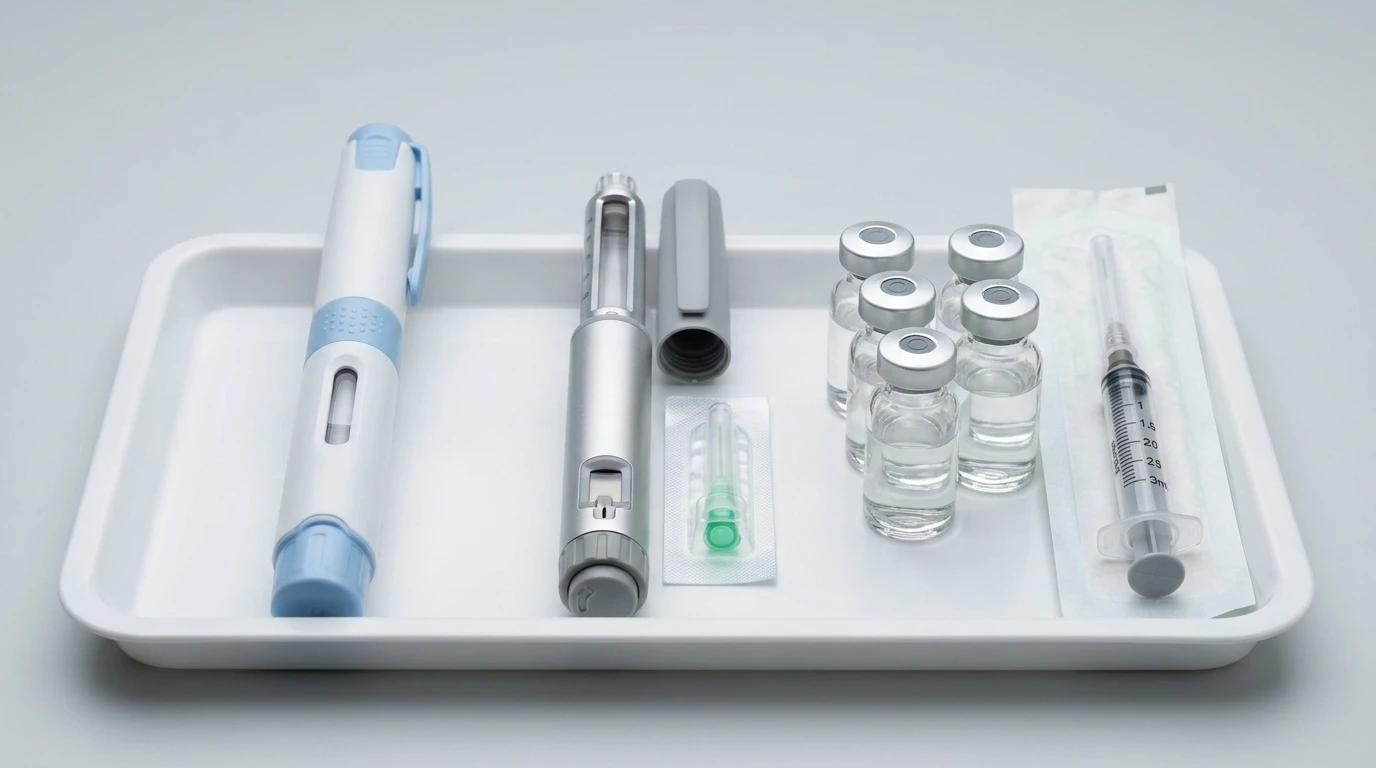
Zepbound comes in several forms, and the form affects the price more than most people realize. The FDA-approved label lists single-dose pens, single-dose vials, multi-dose vials, and single-patient-use KwikPens. These three matter most for what you pay:
Every form contains the same active ingredient, Tirzepatide. Mounjaro®, the brand approved for type 2 diabetes, also contains Tirzepatide. Our page on Tirzepatide, Mounjaro, and Zepbound explains how the products relate. If you’re comparing Tirzepatide without insurance across brands, remember that only Zepbound is FDA-approved for weight management. For a self-pay patient on an equal dose, the vial and the KwikPen cost the same. The choice usually comes down to whether you prefer a pen or a syringe, which pharmacy you use, and whether Medicare’s Bridge applies to you.
Every legitimate way to get Zepbound starts with a prescription, and that is where many people without insurance get stuck. You can get one from:
Whichever route you choose, a proper evaluation should include your medical history, current medications, any personal or family history of medullary thyroid cancer or MEN 2, pregnancy plans, your BMI and weight-related conditions, and lab work where appropriate. A prescription written after a five-minute questionnaire, with no follow-up, may look cheap at first. But dose changes, side effects, and plateaus all need a clinician who knows your history, and that follow-up is part of what keeps treatment safe and keeps it working.
In South Florida, Cardiomender Weight Loss & Aesthetics prescribes and manages Zepbound in person at our Pembroke Pines clinic. You can see what that involves on our Zepbound weight loss page, read how the first visit works on our getting started page, or learn about our broader medical weight loss program in Pembroke Pines. Cardiomender’s services are available to Florida residents only. Once you have a prescription, you choose where to fill it, whether LillyDirect, a participating pharmacy, or your insurance if it covers the drug.
Before you plan a budget, make sure Zepbound is actually an option for you. According to the FDA-approved prescribing information on DailyMed, Zepbound is approved, together with a reduced-calorie diet and increased physical activity:
In the clinical trials, “obesity” meant a BMI (body mass index) of 30 or higher. “Overweight” meant a BMI of 27 to under 30 together with at least one weight-related condition. Zepbound should not be combined with other Tirzepatide-containing products or with any other GLP-1 receptor agonist (the drug class that includes Semaglutide). Use outside these approved indications isn’t something a responsible prescriber should offer just because you’re paying cash. The approval is the same no matter how you pay.
At $4,000 or more a year, it’s reasonable to ask what you’re getting for the money. The best evidence comes from Lilly’s SURMOUNT trial program.
In SURMOUNT-1, published in the New England Journal of Medicine in 2022, 2,539 adults with obesity, or with overweight plus a weight-related condition, took weekly Tirzepatide or a placebo for 72 weeks, alongside lifestyle counseling. Average weight loss was 15.0% on 5 mg, 19.5% on 10 mg, and 20.9% on 15 mg, compared with 3.1% on placebo. Between 85% and 91% of people taking Tirzepatide lost at least 5% of their body weight, compared with 35% on placebo. These are averages from a controlled trial, and individual results vary. Some people lose much more, and some lose much less. Our article on Tirzepatide weight loss results shows what progress typically looks like, and why you might not be losing weight on Tirzepatide covers the common reasons for a slow response.
This is the part of the cost question most guides leave out. In SURMOUNT-4, published in JAMA in 2024, participants first took Tirzepatide for 36 weeks and lost an average of 20.9% of their body weight. They were then randomly assigned either to continue Tirzepatide or to switch to a placebo for another 52 weeks. Those who continued lost a further 5.5% on average. Those switched to placebo regained 14.0%. In the continuing group, 89.5% kept at least 80% of the weight they had lost, compared with 16.6% of the placebo group. The researchers concluded that “withdrawing tirzepatide led to substantial regain.”
The practical lesson is to price the plan you can sustain, not just the first two months. If you can afford the starting doses but not the maintenance phase, talk with your clinician before you start, not after. A plan that builds habits from the beginning also matters. Nutrition, strength training to protect muscle, and regular monitoring are what help results last. At Cardiomender, our clinicians pair medication with nutrition guidance and lifestyle coaching, and they work with patients on a long-term plan for maintaining results. For some patients, that plan includes reducing medication over time under supervision, but that is a medical decision made for each patient. It isn’t a promise that applies to everyone. Two practical guides help here: what to eat on Tirzepatide and how to limit muscle loss on Tirzepatide.
Paying cash doesn’t change the safety profile, and side effects are one of the main reasons people stop treatment early, which wastes money. The FDA label reports these rates of common digestive side effects in pooled trials (placebo compared with 5 mg / 10 mg / 15 mg):
| Side effect | Placebo | 5 mg | 10 mg | 15 mg |
|---|---|---|---|---|
| Nausea | 8% | 25% | 29% | 28% |
| Diarrhea | 8% | 19% | 21% | 23% |
| Vomiting | 2% | 8% | 11% | 13% |
| Constipation | 5% | 17% | 14% | 11% |
In SURMOUNT-1, digestive side effects were mostly mild to moderate and occurred mainly while the dose was being increased. Stopping because of side effects was uncommon: 4.3%, 7.1%, and 6.2% on the three doses, compared with 2.6% on placebo.
Other important safety points from the label:
Based on the FDA Medication Guide, stop using Zepbound and get medical help right away if you have:
If you’re having trouble breathing or think you’re having an emergency, call 911.
Contact your clinician promptly if you have:
If you search for Zepbound without insurance, you’ll see offers well below Lilly’s self-pay prices. Here is what the FDA says about them, as of October 2026.
There is no FDA-approved generic Zepbound. Compounded Tirzepatide is something different. The FDA’s page on concerns with unapproved GLP-1 drugs used for weight loss states that “compounded drugs are not FDA approved.” Unapproved versions “do not undergo FDA’s review for safety, effectiveness and quality,” and counterfeit products “could contain the wrong ingredients.” As of May 31, 2026, the FDA had received more than 730 reports of adverse events associated with compounded Tirzepatide. The agency notes that adverse events from compounded drugs are likely underreported. The FDA has also taken action against sellers who used the Zepbound name for compounded products. In a September 2025 warning letter to an online seller, it found that marketing compounded Tirzepatide as “Zepbound,” or as FDA-approved, was false or misleading.
Red-flag checklist: walk away if an offer…
For more background, read our explainers understanding compounded Semaglutide and Tirzepatide and tips when considering compounded Semaglutide or Tirzepatide. If you’re unsure whether a product is legitimate, ask a licensed clinician or pharmacist before you pay.
Once you have a prescription and know your channel, these steps keep the total down without cutting corners:
What changes on January 1, 2027. Every current Zepbound savings card, including the self-pay card, the commercial covered card, and the non-covered card, says the “card expires and savings end on 12/31/2026.” The Medicare GLP-1 Bridge is scheduled to run through December 31, 2027. Lilly may renew or change its programs, but no one knows the 2027 terms yet. If you start Zepbound now, check the current terms again in early January before your first refill of the new year.
Zepbound isn’t the only FDA-approved medication for weight management, and it isn’t the right fit for everyone. If the numbers above don’t work for your budget, ask your clinician about the alternatives. Each has a different cost, a different average result, and a different side-effect profile:
When you pay out of pocket, it’s tempting to look only at the cheapest prescription. But the medication only works when the plan around it does. Here’s how Cardiomender approaches care for patients who are considering Zepbound:
You can read more about our approach, or see how we manage Tirzepatide treatment in Pembroke Pines. Our clinicians will also tell you plainly if Zepbound isn’t the right fit for you.
As of October 2026, Lilly’s self-pay program prices the KwikPen and vials at $299 a month for 2.5 mg, $399 for 5 mg, and $449 for 7.5 mg through 15 mg, if you refill within 45 days. A late refill raises the price for 7.5–15 mg to $499–$699. Doctor visits, labs, and supplies are extra.
For most uninsured people, the cheapest legitimate option is the self-pay KwikPen or vials, bought through LillyDirect or a participating retail pharmacy with the self-pay savings card. Refilling on time and staying on a dose your clinician agrees is appropriate keeps the cost lowest. If you’re on Medicare and meet the Bridge criteria, the $50 copay is lower still.
No. The “as low as $25” savings card applies only when a commercial insurance plan covers Zepbound. If you have no insurance, use the separate self-pay savings card for the KwikPen or vials.
No. TrumpRx shows Zepbound vials starting at $299 a month, and its product page says Lilly handles all Zepbound vial orders through LillyDirect. It’s another way into the same self-pay pricing, not a lower price.
From any licensed clinician who can evaluate you: a primary care provider, an obesity medicine specialist, a medical weight-loss clinic, or a licensed telehealth service. You pay for the visit yourself. Choose a prescriber who will also follow you through dose changes and side effects, not just write a single prescription.
No. The $299–$449 self-pay price covers the medication only. Initial and follow-up visits, lab work, and supplies such as syringes or pen needles are separate costs, so ask any provider for their full program cost before you start.
No, there is no FDA-approved generic Zepbound. Compounded Tirzepatide is not FDA-approved. The FDA has warned sellers who marketed compounded products under the Zepbound name or as FDA-approved.
Often, yes. IRS Publication 502 counts prescribed medicines and weight-loss treatment for a physician-diagnosed disease, such as obesity, as medical expenses. Rules vary by plan, so confirm with your HSA or FSA administrator before you buy.
Through the Medicare GLP-1 Bridge, which began July 1, 2026, eligible beneficiaries pay a $50 copay for the Zepbound KwikPen. You must meet the BMI and health criteria, and your prescriber has to submit a prior authorization. Coverage for sleep apnea goes through your regular Part D plan.
In the SURMOUNT-4 trial, people who stopped Tirzepatide after 36 weeks regained an average of 14.0% of their body weight over the following year. People who continued lost a further 5.5%. If cost could force you to stop, plan the transition with your clinician rather than stopping suddenly on your own.
Nobody knows yet. Every current Zepbound savings card says it expires on December 31, 2026, while the Medicare Bridge is set to run through December 31, 2027. Check Lilly’s current terms in early January before your first refill of the new year.
Figuring out how to get Zepbound without insurance is easier with a clinician who will be honest about both the price and whether the medication fits you. Cardiomender Weight Loss & Aesthetics serves patients across South Florida from our Pembroke Pines clinic at 17009 Pines Blvd. To talk with our team about your options, call (954) 799-6439 or schedule your consultation.
Our physician-supervised weight loss and aesthetic programs are designed around your unique body, goals, and lifestyle.