Discover how much weight can you lose on semaglutide. On average, patients lose 15% of their starting body weight under medical supervision.
Patients taking Semaglutide under medical supervision can expect to lose an average of 15% of their starting body weight over a 68-week period. This translates to a sustainable rate of 1 to 2 pounds per week, resulting in an average weight loss of 5 to 10 pounds during the first month. For individuals seeking accelerated metabolic intervention, dual-agonist options like Tirzepatide may yield higher total weight loss averages of up to 20.9%, but Semaglutide remains the foundational clinical standard. Success depends on following a progressive titration schedule to avoid adverse gastrointestinal events while preserving critical muscle tissue. At Cardiomender, MD Weight Loss Specialists, our Pembroke Pines clinic designs customized medical protocols to support sustainable weight management, serving patients throughout Broward County and surrounding South Florida areas. To achieve these benchmarks safely, clinical oversight must guide dosage escalations, nutritional strategies, and hormone optimization.
Disclaimer: The following information is for educational purposes only and does not replace professional medical advice. Always consult a board-certified physician before starting any clinical weight loss or prescription medication program.

Clinical data confirms that patients achieve substantial weight reduction when combining Semaglutide with structured lifestyle modifications. In the landmark STEP 1 clinical trial published in The New England Journal of Medicine, adult participants using a 2.4 mg weekly dose of Semaglutide experienced an average weight loss of 14.9% to 15% of their baseline body weight over 68 weeks. This cohort received standard lifestyle counseling to support their dietary and physical activity changes throughout the study period. The U.S. Food and Drug Administration (FDA) approved this GLP-1 receptor agonist for chronic weight management based on these highly consistent safety and efficacy markers.
For a patient starting their program at 220 pounds, a 15% reduction represents a loss of approximately 33 pounds. This outcome far exceeds the results of traditional lifestyle interventions alone, which typically yield a 3% to 5% reduction in body weight. To understand your realistic progress, consider these key clinical guidelines:
At CardioMender, MD, we serve patients across South Florida, including Fort Lauderdale, Miramar, Weston, and Hollywood, from our primary Pembroke Pines clinic. We focus on treating the physiological root causes of weight gain rather than offering a temporary fix. Our medical team monitors your biomarkers to ensure your weight reduction consists of adipose tissue rather than muscle mass.
Your physiological response to Semaglutide follows a structured sequence aligned with your medication titration schedule. Patients must understand that this gradual approach prevents severe gastrointestinal side effects while allowing the metabolism to adapt. Adjusting your body to the active peptide ensures long-term compliance and steady progress.
Medical protocols initiate Semaglutide at a low dose of 0.25 mg injected subcutaneously once weekly. This initial phase prepares your gastrointestinal system and brain receptors for the peptide without overwhelming your digestive tract. During these first four weeks, the expected weight loss is typically 5 to 10 pounds. A portion of this initial drop represents a reduction in water retention, as systemic inflammation decreases and insulin sensitivity begins to improve. You will notice early appetite suppression and delayed gastric emptying, meaning you feel full longer after eating smaller portions.
At week five, your supervising physician increases the weekly dose to 0.5 mg, eventually escalating to 1.0 mg by week nine. As the concentration of the medication increases in your system, receptor binding in the hypothalamus strengthens. This escalation stabilizes your weight loss at a highly consistent rate of 1 to 2 pounds per week. During this phase, food cravings subside, and the metabolic rate stabilizes. Patients learn to recognize natural satiety signals, allowing them to establish healthy portion control habits easily.
By the fourth month, patients transition to the therapeutic doses of 1.7 mg or 2.4 mg weekly, depending on individual tolerance and clinical response. At the six-month mark (24 weeks), many patients have safely shed 10% or more of their initial body weight. The weight loss remains steady before eventually reaching a plateau, where the body establishes a new metabolic set point. Our medical team continues to monitor your markers to maintain this therapeutic progress while preserving lean tissues.
Losing weight too rapidly presents distinct medical hazards, including gallbladder complications, severe nutritional deficiencies, and facial volume depletion. When patients drop weight too fast, the body burns skeletal muscle for energy, which permanently slows the basal metabolic rate. Utilizing a medically supervised protocol with weight loss injections in Pembroke Pines ensures your body burns fat while keeping your muscle tissue intact.
Our board-certified medical team uses advanced bioelectrical impedance analysis to track your precise body composition weekly. If we detect muscle loss, we immediately adjust your daily macronutrient targets and therapeutic support to safeguard your metabolic health.

Long-term clinical data shows that weight reduction continues steadily over several months before stabilizing into a maintenance phase. Understanding the difference between short-term drops and long-term metabolic shifts helps you maintain realistic expectations for your health investment. Your progress over a half-year to a full year reflects deep changes in metabolic function and fat distribution.
At the six-month interval, patients under consistent medical supervision average an 8% to 10% reduction in baseline body weight. For an individual starting their program at 200 pounds, this represents a documented loss of 16 to 20 pounds. At this stage, clinical markers such as fasting blood glucose, HbA1c, and blood pressure show highly significant clinical improvements. Visceral fat surrounding internal organs decreases, which reduces cardiovascular risk and systemic inflammation.
As patients reach one year of continuous therapy, the average weight loss reaches 12% to 15% of their starting weight. A 200-pound patient will have typically lost 24 to 30 pounds of adipose tissue. At this point, the body has adapted to its new physical mass, and metabolic rate adaptation begins to level off. Consistency in medication compliance and lifestyle habits during this period determines whether the patient maintains these results over the long term.
Several physiological variables influence the speed and overall success of your weight loss program:
While clinical trials occur in highly controlled environments with selected patient cohorts, real-world results can vary. In clinical practice at CardioMender, MD, we frequently observe that patients who receive personalized medical care achieve highly sustainable results. Addressing hormone imbalances and nutritional deficiencies prevents the common weight loss plateaus that trial participants often face.
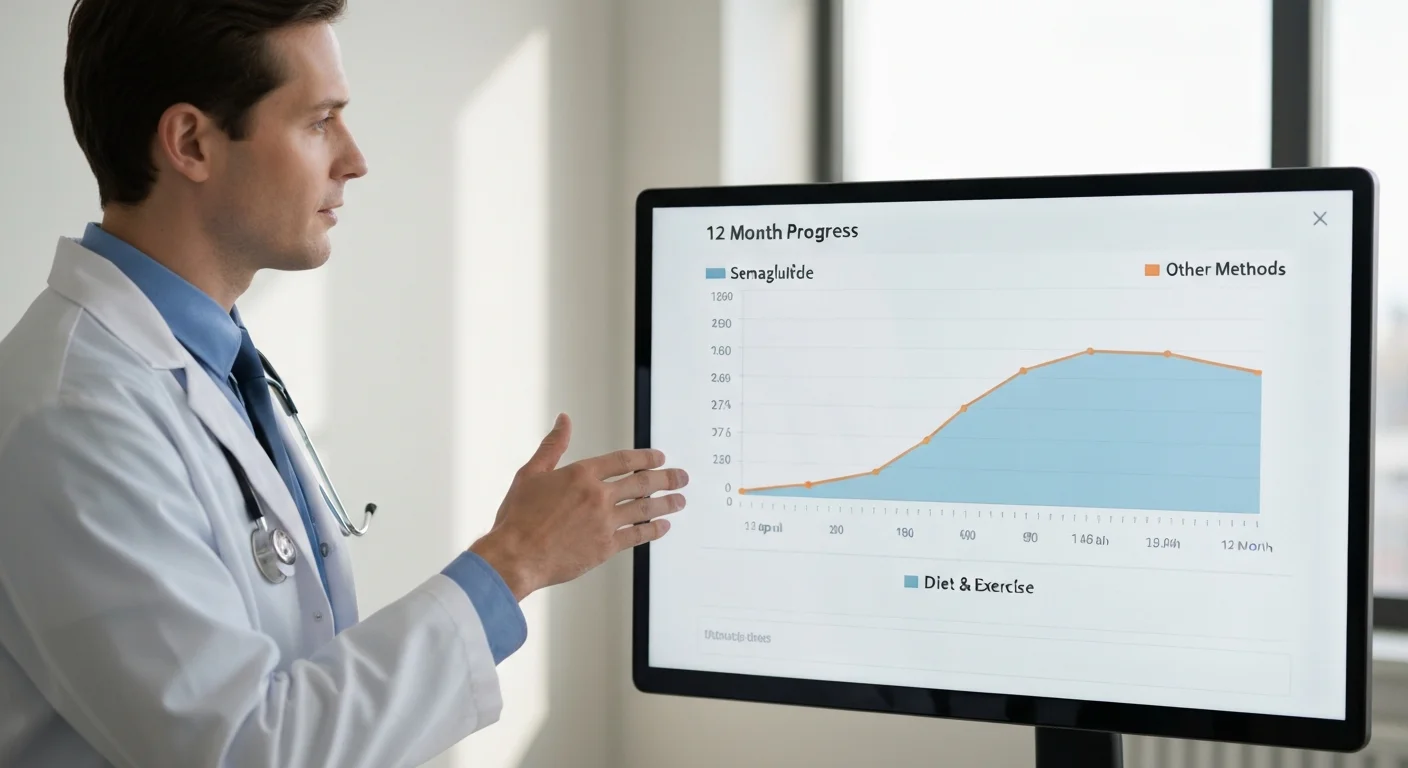
To evaluate if Semaglutide is the correct choice for your medical goals, comparing its performance against alternative treatments is highly beneficial. Different clinical tools utilize distinct physiological pathways, resulting in varying rates of weight reduction and clinical timelines. Understanding these mechanisms helps you choose a therapy that matches your health profile, lifestyle, and budget.
Pricing for medical weight loss programs in South Florida ranges from $150 to $400 per month for premium, fully supervised medical programs, compared to higher costs for retail brand-name prescriptions. Reviewing Weight Loss Program Pricing helps patients plan their long-term wellness investment. The following table compares Semaglutide with other common medical interventions and traditional methods:
| Medication / Method | Average Total Weight Loss (% of Body Weight) | Typical Timeline to Peak Results | Primary Mechanism of Action |
|---|---|---|---|
| Semaglutide (Ozempic® / Wegovy®) | 15% | 68 Weeks | Single GLP-1 receptor agonist; delays gastric emptying and enhances satiety. |
| Tirzepatide (Mounjaro® / Zepbound®) | 15% to 20.9% | 72 Weeks | Dual GIP/GLP-1 receptor agonist; utilizes dual metabolic pathways. |
| Phentermine | 5% to 7.5% | 12 to 24 Weeks | Sympathomimetic stimulant; suppresses appetite via the central nervous system. |
| Traditional Diet & Exercise | 3% to 5% | Highly Variable | Caloric deficit; highly prone to metabolic adaptation and weight regain. |
Clinical trials indicate that Tirzepatide may produce a faster rate of initial weight loss due to its dual-receptor activation. However, Semaglutide remains an exceptionally reliable and highly effective cornerstone of clinical weight management. It offers a well-established safety profile, excellent cardiovascular benefits, and consistent long-term results. The medication is highly accessible and serves as an ideal treatment option for many patients in South Florida.
Some patients who experience a weight loss plateau or require enhanced glycemic control may benefit from switching from Semaglutide to Tirzepatide. Our medical specialists manage this transition safely, adjusting your dosage to prevent unwanted side effects while keeping your weight loss on track. We serve patients from Davie, Weston, Pembroke Pines, and Cooper City with tailored medical transitions.
Most patients lose between 5 to 10 pounds during the first month of treatment. This initial progress occurs on the lowest starting dose of 0.25 mg weekly, which is designed to let your body adapt to the medication. This gradual introduction helps minimize mild digestive side effects like temporary nausea or changes in bowel habits.
You can optimize your progress by prioritizing high-protein nutrition, staying hydrated, and performing resistance exercises to maintain muscle mass. Identifying and correcting underlying metabolic obstacles, such as thyroid dysfunction or sex hormone deficiencies, also helps prevent plateaus. Our Pembroke Pines clinical team evaluates these physiological factors to ensure you burn fat efficiently.
Tirzepatide targets both GIP and GLP-1 receptors, which has shown slightly higher and faster weight loss averages of up to 20.9% in clinical studies. However, the best option depends on your health profile, clinical history, and treatment tolerability. Our medical team guides you toward the most appropriate medication for your long-term success.
You may consider transitioning if you experience a prolonged weight loss plateau or if your appetite suppression decreases at maximum doses. Patients also switch if they experience persistent side effects that do not resolve with dosage adjustments. Our physicians can design a safe cross-titration plan to transition your medication smoothly.
Clinical observations from The Journal of the American Medical Association (JAMA) show that patients can regain weight if they discontinue the medication without establishing permanent lifestyle habits. To prevent this, CardioMender, MD combines peptide therapy with metabolic optimization and custom nutritional guidance. This comprehensive approach helps you maintain your weight loss results long after completing your medication program.
Our dedicated medical team provides professional care to help you achieve your weight loss goals. We offer comprehensive support to ensure you lose weight safely and maintain your results over the long term. If you are ready to explore your options, schedule a consultation for Semaglutide treatment in Pembroke Pines, FL, or call CardioMender, MD Weight Loss Specialists at (954) 799-6439 to discuss your customized treatment plan.
Our physician-supervised weight loss and aesthetic programs are designed around your unique body, goals, and lifestyle.