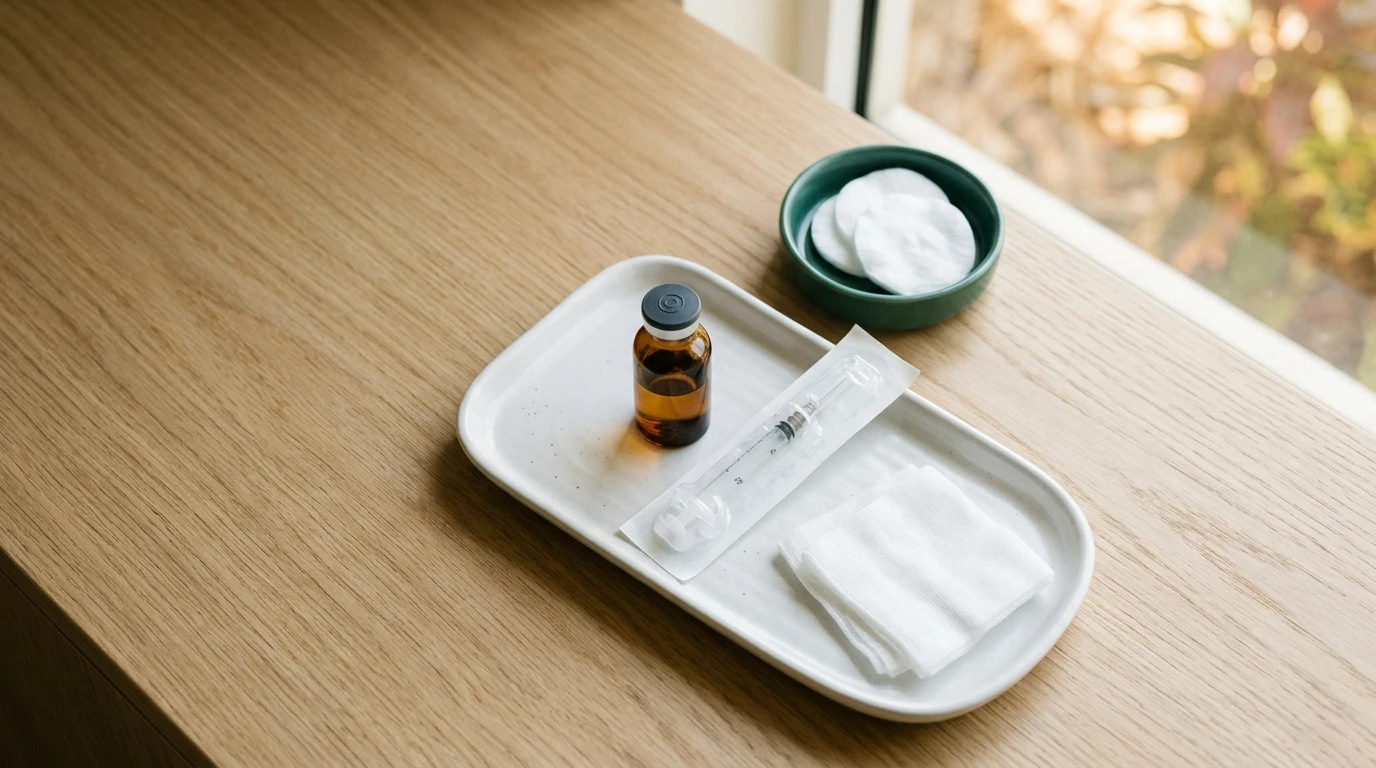
How long does Botox last? For most people, Botox® results last about 3 to 4 months. That is the duration the FDA prescribing label for Botox Cosmetic gives for frown lines, and it matches a May 2026 article in American Family Physician. The first changes begin one to two days after treatment, build through the…
How long does Botox last? For most people, Botox® results last about 3 to 4 months. That is the duration the FDA prescribing label for Botox Cosmetic gives for frown lines, and it matches a May 2026 article in American Family Physician. The first changes begin one to two days after treatment, build through the first week and take about 2 weeks to fully develop. Some people see movement return a little sooner and some a little later, so results may vary. This guide walks through what the FDA trial data actually measured month by month, how long Botox injections last in each treatment area, why the effect wears off, and what can (and can’t) help it last. At Cardiomender Weight Loss & Aesthetics in Pembroke Pines, our aesthetics team starts every Botox plan with exactly this conversation.
This quick-reference table summarizes what typically happens after a frown-line treatment. The percentages are investigator-rated responder rates from the FDA label’s glabellar-line trials; your own timeline may differ.
| When | What to expect |
|---|---|
| Treatment day | Possible swelling, redness, tenderness or bruising at the injection sites (FDA label; American Family Physician) |
| Days 1–2 | The toxin begins to relax the injected muscles (FDA label) |
| Week 1 | The effect keeps building; 74% of trial patients were responders at Day 7 |
| Week 2 | Full effect develops; a good time for a follow-up check |
| Month 1 | Peak response in the trials: 80% responders at Day 30 |
| Months 2–3 | Gradual fading: 70% responders at Day 60, 48% at Day 90 |
| Month 4 | 25% responders at Day 120; a pooled analysis of four trials found a median duration of 120 days among Day-30 responders |
| Next step | Book your next treatment once lines and movement return |
The short answer is 3 to 4 months, and three independent sources land on the same range. The FDA label states that “the duration of effect of BOTOX Cosmetic for glabellar lines is approximately 3-4 months.” American Family Physician gives the same range, and the American Academy of Dermatology (AAD) says the effect lasts about 3 to 4 months, “and sometimes longer.”
The most detailed duration estimate comes from a pooled analysis published in Dermatologic Surgery. It combined four trials with 621 patients who received 20 units for frown lines. Among patients who had responded by Day 30, the median duration of effect was 120 days when they frowned as hard as they could and 131 days with the face at rest. More than half of those responders kept a clinical benefit for 4 months, and patient satisfaction rose the longer the effect lasted.
So how long should Botox last before you start to wonder? A gradual return of movement somewhere around the 3- to 4-month mark is normal. Noticeable fading before 2 months, or little visible change at all by the two-week point, is a reason to talk with your injector (see the checklist further down). For details on treatment at our clinic, including the areas we treat, see our Botox treatment page.
One scope note: botulinum toxin is also used for medical conditions such as excessive sweating. Those uses have their own indications, doses and treatment schedules, managed by the treating specialist. This article covers cosmetic treatment of facial lines only.
Most articles stop at “3 to 4 months.” The FDA label goes further: it publishes the share of patients that investigators rated as responders at each visit after a single frown-line treatment. Here is that curve:
| Day after treatment | Responders (investigator-rated) | Patients |
|---|---|---|
| Day 7 | 74% | 299 of 405 |
| Day 30 | 80% | 325 of 405 |
| Day 60 | 70% | 283 of 403 |
| Day 90 | 48% | 192 of 403 |
| Day 120 | 25% | 102 of 403 |
In plain English: the response peaks around the first month, most patients still meet the trial’s responder standard at 2 months, about half do at 3 months and about one in four at 4 months. The label notes that frown-line severity was reduced for up to 120 days compared with placebo.
Why does the pooled analysis report a 120-day median while the label shows 25% responders at Day 120? The two numbers measure different things. The label table counts everyone who still meets the trial’s responder threshold. The pooled analysis followed only patients who had responded at Day 30 and measured how long their benefit lasted by its own criteria. Read together, they say that the effect fades gradually rather than switching off on a set date.
Keep the limits of this data in mind. It covers one area (frown lines), one dose (20 units) and a controlled trial setting. The label also notes that responder rates appeared to be higher in patients younger than 65 than in those 65 or older. Your own result may be shorter or longer.

Botox results are not immediate. According to the FDA label, the initial doses typically produce chemical denervation (relaxation of the injected muscle) one to two days after injection, “increasing in intensity during the first week.” American Family Physician notes that clinical effects typically take 2 weeks to fully develop.
In practice, that means how long it takes for Botox to work depends on what you are watching for. Many people notice softer frown lines within the first several days, but the final result isn’t visible until about two weeks after the appointment. Judging the outcome on day three or four usually means judging it too early.
Because the effect needs about 2 weeks to settle, that is the logical point to assess symmetry and how well the lines have softened. At Cardiomender, a follow-up check-in is scheduled once the full result has developed, to review symmetry, answer questions and plan the next maintenance visit. Whether any adjustment is appropriate is a clinical decision your injector makes after examining you.
How long do Botox injections last in each area? This is where most guides simply repeat “3 to 4 months” for every zone. The FDA label is more specific about which areas Botox Cosmetic is approved for and at what dose, and it gives a duration figure only for frown lines. The table below shows what the evidence actually supports.
| Area | FDA-approved Botox Cosmetic indication? | Labeled dose | What the evidence says about duration |
|---|---|---|---|
| Frown lines (glabellar lines, between the brows) | Yes: moderate to severe glabellar lines | 20 units | Approximately 3–4 months (FDA label) |
| Crow’s feet (lateral canthal lines, around the eyes) | Yes: moderate to severe lateral canthal lines | 24 units | No separate duration figure on the label; your clinician will estimate it from your own response |
| Forehead lines (treated together with frown lines) | Yes: moderate to severe forehead lines | 40 units total (forehead and frown lines) | No separate duration figure on the label |
| Neck bands (platysma bands) | Yes: moderate to severe platysma bands | Per the label and your clinician | No separate duration figure in our sources |
| Lip lines, “lip flip,” jaw (masseter) | Not among Botox Cosmetic’s FDA-approved indications | — | Not covered here; ask a clinician about appropriate options |
Botox is one of several neuromodulators, so if you’d like to compare products, our neuromodulator treatments overview explains how they differ.
How long does Botox last in the forehead? The FDA label approves forehead lines as an indication treated together with frown lines, at 40 units in total, but it doesn’t give a separate duration for the forehead. The 3- to 4-month range comes from the frown-line data. Many patients treat the two areas together, so forehead and frown-line movement often return on a similar schedule, though results may vary.
How long does Botox last around the eyes? Crow’s feet are an FDA-approved indication at 24 units, and the label reports eyelid edema (swelling) in 1% of patients treated for this area. As with the forehead, there is no separate duration figure on the label, so expect your injector to time your next visit by how your own crow’s feet respond.
Botox wearing off is not a sign that something went wrong; it is how the treatment is designed to work. According to the FDA label, Botox relaxes muscles by “inhibiting the release of acetylcholine” (the chemical messenger that tells a muscle to contract). It does this by cleaving SNAP-25, a protein the nerve ending needs to release that messenger.
The nerve doesn’t stay blocked forever. The label notes that reinnervation of the muscle may occur, “thus slowly reversing muscle denervation.” A 2018 paper in the journal Toxins describes this recovery as sprouting: the process by which neuromuscular transmission recovers after botulinum toxin treatment. As those connections rebuild, the muscle gradually regains its strength, and the lines it creates return. That is why Botox is temporary rather than permanent.
Several factors help explain why one person’s results fade at 10 weeks and another’s last longer:
What about sun, exercise, metabolism or zinc? Claims that these shorten or extend Botox circulate widely online, but we couldn’t find clinical evidence strong enough to state them as facts. They aren’t well established, so we don’t present them as reliable ways to change how long Botox lasts.
Many people having Botox for the first time ask whether it will last as long as it does for friends who have been treated for years. There isn’t a separate trial figure for first-time patients. The best guide is the label’s month-by-month curve above, with the understanding that your individual response may vary.
Over a series of treatments, things can change. The AAD notes that with repeat treatment for lines and wrinkles, the muscle may thin, leading to longer-lasting results. The long-term picture still has open questions: the Toxins paper points out that muscle atrophy after chronic exposure to botulinum toxins “has not received sufficient attention” in research. Longer-lasting results with regular treatment are possible, not a given, and worth discussing with your clinician as part of a long-term plan.
For first-time patients, our process at Cardiomender is straightforward: a consultation to review your goals, medical history and how your facial muscles move; customized mapping of the injection sites; the injection itself, which takes minutes; aftercare instructions; and the two-week check-in. You can request an appointment online to start with the consultation.
There’s no proven trick that makes a single treatment last dramatically longer, but some steps are backed by the label or a medical society, and others are just widely repeated.
| Backed by the label or a medical society | Commonly repeated, not established |
|---|---|
| An appropriate labeled dose, placed by a trained injector (FDA label; American Family Physician notes eyelid and brow drooping are technique-dependent) | Taking zinc supplements to “boost” Botox |
| A consistent maintenance schedule; repeat treatment may thin the muscle and lengthen results (AAD) | Avoiding the gym for days afterward to “make it last” |
| The lowest effective dose at the longest feasible interval, which may minimize antibody formation (FDA label) | Facial exercises or “face yoga” to speed results |
| Following aftercare instructions: don’t rub or massage the treated areas (AAD) | The idea that a fast metabolism “burns through” Botox |
For aftercare, the AAD advises not rubbing or massaging the treated areas and waiting two hours before strenuous physical activity. Our clinic’s own aftercare instructions ask patients to stay upright for at least 4 hours and to skip strenuous exercise for 24 hours. Follow the specific instructions your injector gives you.
Sun protection is good general skin care, but there isn’t evidence in our sources that it extends Botox itself. If your concern is sun spots, uneven tone or texture, which Botox doesn’t treat, an IPL photofacial addresses a different problem. Other skin-quality treatments such as AquaGold can also be discussed at your consultation.

How often can you get Botox? The AAD says you can have another treatment when the lines and wrinkles return, which for most people falls around the 3- to 4-month mark. There is also a firm lower limit: the FDA label states that “the safety and effectiveness of dosing with BOTOX Cosmetic more frequently than every 3 months have not been clinically evaluated.” So a shorter interval isn’t a schedule to aim for, even if your results fade early.
Spacing treatments out also matters for antibodies. In the label’s data, 14 of 916 Botox Cosmetic patients (1.5%) developed binding antibodies, and none (0%) developed neutralizing antibodies, the type that can block the effect. The label advises that the potential for antibody formation may be minimized by using “the lowest effective dose given at the longest feasible intervals between injections.”
A practical Botox maintenance plan, then, means booking when movement returns, at intervals of no less than 3 months. Patients who plan regular visits can ask about our membership options.
Patients often ask how long Dysport® lasts, or whether Xeomin® or Jeuveau® outlasts Botox. The honest answer is that unit-for-unit comparisons don’t work. The FDA label states that Botox Cosmetic is not equivalent to other botulinum toxin products, so “20 units” of one brand isn’t the same dose as 20 units of another.
A study of 85 patients published in Dermatology and Therapy found a higher response rate in the frown-line area at 4 months with abobotulinumtoxinA (Dysport): 83% versus 48% with Botox. But the two products were compared at a dose ratio of 2.5:1 in the frown-line area and 3:1 for crow’s feet, so the study can’t show that one product lasts longer at a truly equivalent dose. The same paper describes the perceived advantage in onset and duration as “largely anecdotal.” Dysport and Xeomin are discussed here for comparison only.
Jeuveau (prabotulinumtoxinA) was approved by the FDA in February 2019 for the temporary improvement in the appearance of moderate-to-severe glabellar lines. In trial data summarized in a 2021 paper in Annals of Pharmacotherapy, 87.2% of Jeuveau patients showed improvement in frown lines at maximum frown on Day 30, compared with 82.8% of Botox patients. That comparison is at Day 30, not a duration measurement, and our sources don’t give a month-by-month duration figure for Jeuveau. How long Jeuveau lasts for you depends on dose and individual response. Our Jeuveau treatment page explains how it’s used at our clinic.
The first signs are usually subtle: frown lines reappear when you concentrate, crow’s feet return when you smile, or your brows lift more easily again. Movement comes back gradually, not overnight. Use this checklist to sort normal fading from something worth a call:
| What you notice | What it usually means | What to do |
|---|---|---|
| Movement and lines gradually returning around 3–4 months | Normal fading | Book your next maintenance visit |
| Little or no visible change two weeks after treatment | Possible under-response; the effect should be fully developed by about 2 weeks | Schedule a follow-up with your injector |
| Results fading clearly before 2 months, treatment after treatment | Dose, area or individual variation; rarely, antibodies | Review your plan with your clinician; don’t shorten the interval below 3 months |
| A drooping eyelid or brow, or noticeable asymmetry | A known, usually temporary side effect (eyelid ptosis in 3% of frown-line patients on the label) | Call the clinic that treated you |
| Trouble swallowing, speaking or breathing, or generalized weakness | Possible spread of toxin effect | Seek immediate medical care (see below) |
Botox carries an FDA boxed warning about the spread of toxin effect beyond the injection site. Symptoms listed on the label include generalized muscle weakness, double vision (diplopia), drooping eyelids, difficulty swallowing (dysphagia), voice or speech changes, loss of bladder control and breathing difficulties. The label advises patients to “seek immediate medical care if swallowing, speech or respiratory disorders occur.” If you have trouble breathing or swallowing, call 911 or go to the nearest emergency room.
For context, the label also states that there have been no definitive serious adverse event reports of distant spread associated with dermatologic use of Botox Cosmetic at the labeled dose. Serious reactions are not expected with cosmetic treatment, but the warning signs are worth knowing.
Most side effects are minor. According to the FDA label, localized pain, tenderness, swelling, redness and bruising may occur at the injection sites, and American Family Physician notes that minor bruising and swelling can occur. The AAD adds that when side effects develop, they tend to be mild and temporary.
The label reports these adverse reactions by treatment area:
American Family Physician describes temporary eyelid and eyebrow drooping as technique-dependent complications, which is one reason injector training and careful mapping matter.
Who should not get Botox, or needs extra caution:
FDA scope: Botox Cosmetic is FDA-approved for moderate to severe glabellar (frown) lines, lateral canthal lines (crow’s feet), forehead lines and platysma (neck) bands. Uses beyond these cosmetic indications are not covered in this article. Results may vary, and the goal of treatment is natural-looking results, not a frozen face. Please also review our medical disclaimers.
Knowing that Botox lasts about 3 to 4 months is useful; turning that into a sensible, safe schedule is where an experienced clinic helps. Here’s how Cardiomender approaches it:
You can meet the clinicians on our team, read what patients say in our patient reviews, and check our clinic hours to find a visit time that fits.
Many of our patients are also working on significant weight loss, sometimes with GLP-1 medications. That brings up a question Botox can’t answer alone. Botox relaxes the muscles that cause expression lines; it doesn’t restore facial volume that can be lost when weight comes off. If hollowing or sagging is the concern, that’s a separate conversation, covered in our guide on how to prevent “Ozempic face”, and treatments such as dermal fillers or Radiesse® may be discussed instead of, or alongside, Botox. Our clinicians look at the whole picture, including your medical weight loss program in Pembroke Pines, before recommending an aesthetic plan.
No. Botox blocks the nerve signal to the treated muscle temporarily. According to the FDA label, reinnervation of the muscle may occur, slowly reversing the effect, and research describes nerve sprouting as the way muscle function recovers. That’s why treatment needs to be repeated to maintain results.
As the effect fades, movement and lines gradually return toward how they looked before treatment. None of our sources indicate that stopping Botox speeds up aging. The change happens slowly over weeks, not suddenly.
The treated muscles gradually regain their full movement as nerve connections recover, and expression lines return to their natural pattern. If you’re considering a break, talk with your clinician about what to expect for your specific areas. Results may vary.
According to the AAD, with repeat treatment the muscle may thin, which can lead to longer-lasting results. However, the 2018 Toxins paper notes that muscle atrophy after long-term botulinum toxin exposure hasn’t received sufficient attention in research. A long-term plan is best built and reviewed with your clinician over time.
Early fading can come from the dose used, the area treated, the strength of your muscles or individual variation. Rarely, antibodies play a role: in the label’s data, 1.5% of patients developed binding antibodies and none developed neutralizing antibodies. Book a review with your injector rather than retreating early, because dosing more often than every 3 months hasn’t been clinically evaluated.
There’s no separate first-time figure. The FDA trial curve is the best guide: 80% of patients were responders at Day 30, 48% at Day 90 and 25% at Day 120. With repeat treatment, the AAD notes that results may last longer as the muscle thins.
Published trial data compare Jeuveau and Botox at Day 30, when 87.2% of Jeuveau patients and 82.8% of Botox patients showed frown-line improvement, according to the 2021 Annals of Pharmacotherapy paper. Our sources don’t give a month-by-month duration for Jeuveau, so your clinician will estimate it from your own response.
The AAD advises waiting two hours before strenuous physical activity. Our clinic’s aftercare asks patients to stay upright for at least 4 hours and to skip strenuous exercise for 24 hours, so follow the instructions you receive at your appointment.
For appropriate patients treated at labeled doses, side effects are usually mild and temporary, such as bruising, swelling or headache, according to the AAD and the FDA label. Less common effects include eyelid or brow drooping. It isn’t right for everyone, including people with a botulinum toxin allergy, an infection at the injection site or certain neuromuscular disorders, which is why a medical consultation comes first.
Ready to plan Botox around a realistic 3- to 4-month timeline? Cardiomender Weight Loss & Aesthetics welcomes patients from across South Florida at our Pembroke Pines clinic, 17009 Pines Blvd. Call us at (954) 799-6439 or contact our team to schedule your consultation.
Our physician-supervised weight loss and aesthetic programs are designed around your unique body, goals, and lifestyle.